Critical Inquiry Critical Inquiry

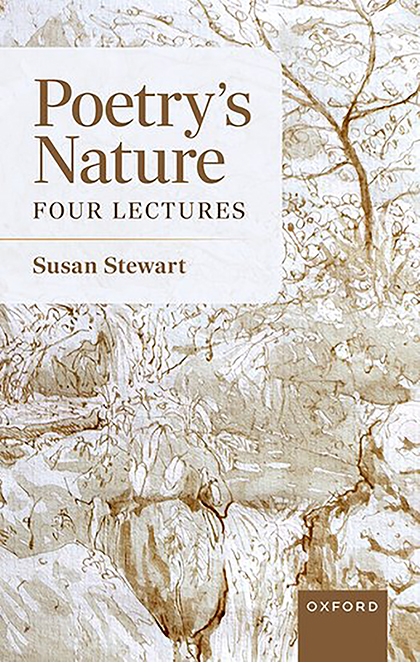
Susan Stewart. Poetry’s Nature: Four Lectures. New York: Oxford University Press, 2025. 160 pp.
Review by Feng Dong
24 September 2026
“Poetry’s nature” carries at least three meanings. It’s about nature itself apprehended through poetry, the nature of poetry as a verbal art, and, more generally, the deep entwinement of poetic making with the natural process. A signifying process employing trope and rhythm, poetry exceeds being a temporary container of natural force by enchanting us into “participating in the excess, the superfluidity of meaning, that nature draws upon and toward which it draws us” (p. 3). Both nature and poetry direct our attention to the emanation of meaning from a source that is vibrant and rhythmic, felt by poets and readers alike, as well as by philosophers and scientists, who approach nature most prosaically yet occasionally poetically. When we contemplate a poem, focusing on its language, we are simultaneously transported by what words, sounds, forms, and patterns reveal, and we breathe the outside of the poem. Stewart’s reading of William Wordsworth’s “A Slumber Did My Spirit Seal” exemplifies a critic’s tenacious pursuit of the estranging effects of the supersensible in a poem. Here we stop taking natural phenomena as merely natural and begin to desire to know and feel more about them, to plunge into their unexplained and perhaps inscrutable core, participating in “the indiscernible movements of earth’s diurnal course” via the poem (p. 64). Stewart’s insight is that poetry arises from a deep desire to bring into intimacy what remains outside human subjectivity, to create a channel between the two realms. Poetry, thinking and feeling nature both outside and inside, is just such a medium for “anthropomorphizing ourselves and taking responsibility for our powers,” and, in the case of the sublime, for registering our powerlessness before the mighty, which still lacks a form (p. 1).
Stewart has a strong ecological awareness in understanding poetry, yet her treatment differs from ecocriticism in that she does not hypostatize nature as a substance or system nor does she valorize nature’s making over human making, such as the making of a poem. She seems allergic to any system, since the term connotes automatism and closure; she is more concerned with how poetry, particularly in the Anglo-American traditions, reshapes readers’ experiences of nature and informs their senses of time, motion, mortality, and wilderness. Poetry’s nature is coextensive with, or even more far-reaching than, nature’s nature, if we allow this formulation. Reaching beyond self-centered perception and cultural barricades, Stewart’s discussions border on the formless, as she is drawn to natural phenomena such as water, light, wind, seasons, and birdsong, which resist fixed shape. Ecocriticism, more often than not, heats up into a critique of the capitalist mode of production and is thus inescapably agenda-driven. For Stewart, a tireless surveyor of the boundaries between human and natural histories, what nature is and what poetry is remain questions that still resist theoretical settlement. Indeed, what strikes me most in her book is not any new approach to poetry but the unboundedness of her discussion; this is a book without a fixed approach or agenda, a variable book. Maintaining a rare openness, it moves in and out of extant philosophical and scientific discourse to shed light on poetry’s opening up of nature’s dynamics.
One radical truth the author only hints at is that if we were completely natural, we would have no poetry at all (birdsong remains birdsong, and its representation in poetry is a hybrid form). Interestingly, Stewart mentions the Book of Songs from ancient China and notes that the poems engage with “the cosmic year, the passing of the seasons, and weather,” yet early Chinese poetry is also full of political satire and personal grievances (p. 7). One feels that something went wrong very early on, as the Book of Songs records humanity’s protrusion from the natural order. In the Western tradition, Homeric epics present divinities as the driving force behind natural phenomena, while Odysseus, oscillating between teleology and free wandering, has to fight a nature that seems all too strange to him. In her earlier book Poetry and the Fate of the Senses, Stewart considers poetry to be a creation of form out of nothing so as to “counter the oblivion of darkness”; poetic writing aims, or maybe just hopes, to perpetuate a form or a trace of human making against the erasure of time.[1] Over the years, she has deepened her thinking about poetry as a mediation between form and formlessness, the sensible and the gnostic, the knowable and unknowable. Rather than the production of enduring forms, she is now more concerned with poetry’s movement toward the limit of intelligibility; rather than human sensuality, she focuses more on the things’ feeling of one another in poetry that decenters the role of the maker. This is not to relocate “the fate of the senses” to the periphery but to reexamine what makes the senses and therefore poetic sensibility possible in the first place. At times in the present book, she gets very close to poetry’s uncreatedness—a gesture that, I think, distinguishes her work from most critics working today.
Stewart’s entire effort is to keep poetic intelligence alive in the world; it’s a kind of intelligence that seeks out what is out there and feels its encounter with the here and now. Is not a poet someone who has already heard the calling of nonbeing and felt the need to write it down? The withdrawing light in Emily Dickinson’s “A Light Exists in Spring” reminds us of the “unobservable and unspecifiable, and yet the not quite ineffable”; poets are drawn to those aspects of nature hidden from common view, and poetry operates in the wilderness “beyond law and certainty” (p. 87). This mystery, without manifest mysticism, describes a poetics of infinite withdrawal and liminal dwelling. Stewart’s small book clears wonderful paths into the open where nature’s language can almost be understood. I’d take it along if exiled to an island.
[1] Susan Stewart, Poetry and the Fate of the Senses (Chicago, 2002), p. 2.