Critical Inquiry Critical Inquiry

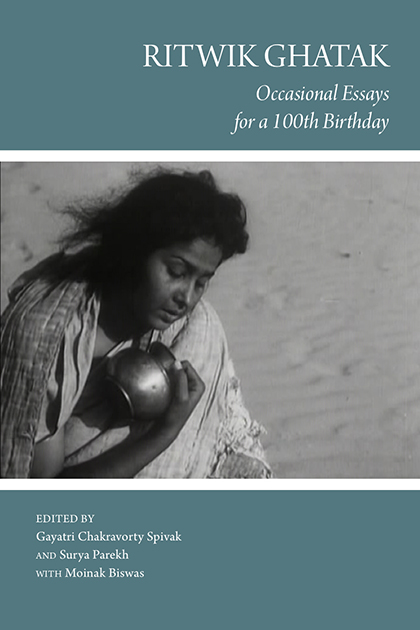
Ritwik Ghatak: Occasional Essays for a 100th Birthday. Ed. Gayatri Chakravorty Spivak and Surya Parekh. Calcutta: Seagull Books, 2026. 200 pp.
Review by Lucky Issar
10 September 2026
It is fitting that the centenary of Ritwik Ghatak—one of the twentieth century’s most powerful filmmakers—is commemorated by this book. Bringing together nine essays by Ghatak scholars from four continents, the volume attests to the global reach of his work.
As Gayatri Chakravorty Spivak writes in her introduction, the contributors sought to test whether Ghatak’s films “would invite encounters that could work through their complex interweaving of historical experience, cultural references, and formal innovations” in order to open new ways of engaging with the present (p. 3). Ghatak's themes of colonialism, nationalism, war, ecological precarity, displacement, and the experience of time are very much with us today, inspiring a sense of uncertainty voiced by many chapters in the volume.
The book thus becomes not only a study of Ghatak but also an attempt to think through how one might live in an increasingly unpredictable world. Yet this engagement is uneven. Some essays reveal nationalist assumptions or echo colonial frameworks. The opening chapters engage with an environmental consciousness of Ghatak’s films, particularly through Anjuli Kolb’s essay, “Ghatak’s Alluvial Forms.” In chapter 3, Udaya Kumar reads Ghatak’s Subarnarekha (1965) through an Indian historical-cultural lens. Whereas some Indian scholars interpret Ghatak largely through an Indian framework—as seen in Moinak Biswas’s captivating essay in which he writes that “Rabindranath is everywhere” in Ghatak’s work—thereby obscuring European intellectual and artistic influences on his cinema, a different but related tendency appears in a few essays by Western scholars that place undue emphasis on reading Ghatak through Bertolt Brecht, as in chapter 4 by Nora Alter (p. 107). Brecht’s ideas of “Verfremdungseffekt” and “epic theatre” significantly shaped modern theatre; however, the repeated emphasis on him risks narrowing the richness of Ghatak’s cinematic imagination (p. 52).
Curiously, in certain respects Ghatak seems closer to Walter Benjamin than to Brecht. Both died young, achieved greater recognition posthumously, and left lasting intellectual legacies. Benjamin’s reflections on history, memory, ruins, and modernity resonate deeply with the temporal and historical imagination that characterizes Ghatak’s cinema. Both were drawn to fragments, historical rupture, and the persistence of the past within the present.
Dudley Andrew’s reading of Ghatak’s Komal Gandhar (1961) stands out for refusing to reduce Ghatak to a single lineage of influence. Instead, Andrew shows how Ghatak absorbed multiple traditions and transformed them into something distinctly his own. While acknowledging Brecht’s importance, Andrew argues that Ghatak “salutes Brecht as an ally—more than an influence—in restoring both scope and folk sources to theatre” (p. 124). Ghatak himself observed that Brecht’s “entire theory of ‘epic’ theatre is based upon a reasoning similar to ours.”[1] For Ghatak, then, Brechtian theatre found an unexpected affinity with India's own living, epic tradition. His engagement with Brecht was therefore not one of mere adoption but of cultural reworking. The essayist’s approach enlarges rather than diminishes our understanding of Ghatak, increasingly seen as the “planetary” or “global” filmmaker (p. 8).
It is unfortunate that the number of authors in this volume is so small. Many writers, theatre practitioners, and filmmakers have engaged deeply with Ghatak’s work; their perspectives could have enriched the collection. Contributions from practicing artists, rather than solely from academics, might have offered new ways of understanding Ghatak as both a filmmaker and a cultural phenomenon.
Reading this volume prompts broader reflections on the reception of Indian cinema. How is it that Ghatak and Satyajit Ray have received greater attention than equally significant filmmakers such as Guru Dutt, Mehboob Khan, and Bimal Roy in global discussions of Indian cinema? Could it be that the films of the latter, characterized by popular appeal, optimism, music, and emotional expansiveness, rarely correspond to the image of India that Western critics have privileged as authentic?
In an accelerated age like ours, the very act of thinking and writing seriously about Ghatak is an achievement. If this volume sends readers back to his films, it will have done its work. It sent this reader back to Komal Gandhar—a film whose opening stills possess the quality of carefully composed paintings, each one inviting us to look, pause, and look again. Above all, it invites us to see Ghatak’s work anew.
[1] Ritwik Ghatak, “Music in Indian Cinema and the Epic Approach,” in Rows and Rows of Fences: Ritwik Ghatak on Cinema (Calcutta, 2000), p. 22.