Critical Inquiry Critical Inquiry

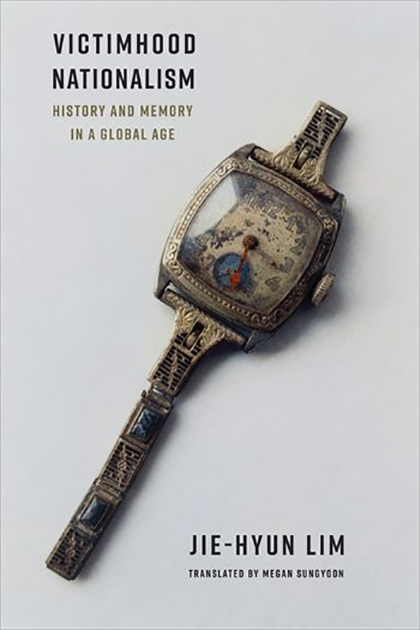
Jie-Hyun Lim. Victimhood Nationalism: History and Memory in a Global Age. Trans. Megan Sungyoon. New York: Columbia University Press, 2025. 440 pp.
Review by Md Imran Ali
18 September 2026
Jie-Hyun Lim’s Victimhood Nationalism asks what happens when entire nations claim the status of supreme victim, and what such a claim does to those whose suffering was real, particular, and irreducible to national allegory. The question seems simple. Its consequences are immense; Lim pursues them across Poland, Germany, Japan, Korea, Israel, Serbia, and further still through sources in seven languages, with a comparativist reach that few scholars have attempted and fewer still have carried off with this degree of philological command.
The method Lim terms “critical relativization” sits at the book’s center (p. 15). He separates it from both the trivialization of atrocity and the competitive hierarchizing of suffering that plagues contemporary memory politics. The Jedwabne pogrom placed beside the Nanjing Massacre, the firebombing of Dresden beside the atomic annihilation of Nagasaki, the instrumentalization of Auschwitz by the Polish Catholic Church beside the Israeli state’s deployment of the Shoah as founding mythology; these juxtapositions refuse to flatten difference while insisting on structural resonances between otherwise incommensurable memory regimes. Juxtaposition, for Lim, never collapses into equivalence. It functions as a refusal of what one might call mnemonic sovereignty, the proprietary claim nation-states exercise over their dead.
In “Juxtaposition,” the book’s most arresting chapter, Lim traces the entanglement of Nagasaki and Auschwitz through Maksymilian Kolbe, the Polish Franciscan martyred at Auschwitz who had earlier built a mission in Nagasaki. Kolbe’s canonization became, as Lim demonstrates with formidable archival detail, a site where Polish Catholic victimhood, Japanese atomic suffering, the quiet erasure of Kolbe’s documented antisemitism, and several competing nationalisms converged into a single hagiographic narrative. The saint belonged to everyone, the antisemite to no one. Kolbe the saint could be appropriated across competing national and religious narratives while the antisemitic dimensions of the historical figure were left unacknowledged within those narratives. Here the book’s method of “radical” is at its sharpest (p. 214).
“Hereditary victimhood,” perhaps the book’s most persistent concept, receives recursive treatment (p. 204). Lim returns to it from Israeli memory politics, then again through Korean mnemonic culture, then once more through the German expellee movement; each pass adds a complicating layer. Victimhood, in his account, is perpetually reforged with each generation, a “cultural memory” that hardens into a “narrative template” capable of absorbing fresh historical content while preserving its essential shape (p. 13). The term ofiara in Polish, Lim reminds us, means both “victim” and “sacrifice”; it is precisely this semantic fusion, this collapsing of the one who suffers into the one who gives, that makes victimhood nationalism so politically potent (p. 51). The dead become national property, their suffering becomes political resource.
Lim defines “mnemonic solidarity” as the critical tension sustained among cacophonous, conflicting memories of suffering across national borders; solidarity, in his account, “is never achieved by flattening different memories into one linear composition” but is sustained through the “cacophony of discrete memories confronting and intertwining” in global memory formation, and it becomes conceivable only when nations sacrifice their proprietary claims to victimhood, permitting their dead to enter into agonistic encounter with the dead of others (p. 316). I am persuaded by the definition’s intellectual force; its operative reach, however, I find insufficient. Lim specifies what mnemonic solidarity refuses (the zero-sum game of competitive victimhood, the reterritorialization of memory within national borders) yet never addresses what would motivate nations, structurally or institutionally, to relinquish the political resource that victimhood provides. The concept would gain sharper purchase, I think, if it confronted the asymmetries of power between memory communities; solidarity between Auschwitz (hypercommemorated) and Namibia (barely acknowledged) demands a reckoning with mnemonic inequality that Lim's own account already substantiates. Namibia, he notes, “was not registered as a site of German-responsible genocide”; yet the Coda never returns to close this gap (p. 99). Its realization would require transnational pedagogical structures and civic institutions that the book invokes in spirit but leaves unspecified.
These are minor reservations about a work of rare ambition. Lim has written across geographies and languages with an intellectual seriousness that makes the parochialism of single-nation memory studies impossible to ignore.