Critical Inquiry Critical Inquiry

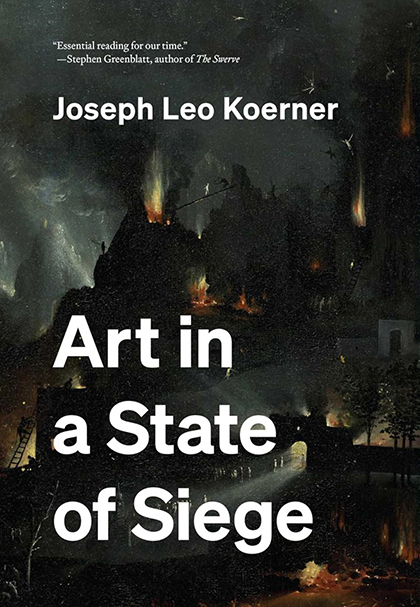
Joseph Leo Koerner. Art in a State of Siege. Princeton, N.J.: Princeton University Press, 2025. 408 pp.
Review by Andrei Pop
5 March 2026
This book links three vexing artists, Hieronymus Bosch, Max Beckmann, and William Kentridge, spanning half a millennium from Northern Europe to South Africa. That arc isn’t perfectly symmetrical: Kentridge lives, Beckmann was born in 1884, and nearly four centuries separate him from Bosch’s attested death in 1516. Joseph Koerner fills the gaps intellectually, rather than chronologically, mainly with brilliant contemporaries of Beckmann’s. There is Aby Warburg, hero of the preface, who wrote a classic of primitivist art history to convince his asylum director that he was fit to release: he was not, because he entertained paranoid fantasies that antisemites had butchered his family and were feeding them to him. Yet Warburg wasn’t so mad: the National Socialists surpassed his worst fears. The delusions, Mnemosyne Atlas, and his ethos of recognizing images in their epochal migration—Koerner presents these all as strategies to survive a state of siege, political and personal, that has never entirely let up.
Other dark intellects fill these pages: Carl Schmitt, the conservative legal theorist who defined politics as the distinction between friend and foe before formulating a Führer principle that would allow Adolf Hitler to rule Germany in a permanent state of exception; Ernst Jünger, WWI veteran and relentless self-promoter, indifferent to Nazidom but eager to live in occupied Paris and scale the Caucus with the Wehrmacht; Schmitt’s friend, the art historian Wilhelm Fraenger, toiling on a mammoth book published after the war under the outrageous title Hieronymus Bosch’s Thousand-Year Reich (1949), which decodes the Garden of Earthly Delights triptych as the manifesto of a secretive free love brotherhood. These big personalities jostle the artists, joined by Koerner’s remarkable family: to wit, his father, Henry Koerner, artist and American officer who escaped his native Austria in 1938 and exhibited magic realist paintings in bombed-out Berlin, where he picked up the first Bosch monograph his son would read.
Art in a State of Siege performs several such dizzying feats of mise en abyme. It is organized not by works or themes but places and dates: we leap from “Cambridge, Massachusetts, 1947,” where Erwin Panofsky delivered Norton Lectures on Early Netherlandish Painting, to “Nuremberg, 1947,” where Schmitt argued successfully against being punished for legitimizing the Nazi dictatorship. Moments of inception, conflict, and viewership are skillfully juggled, as in the masterful final pages, where Kentridge delivers his own Norton Lectures in “Cambridge, Massachusetts, 2012,” before backtracking to “Johannesburg, 1961” for memories of his childhood and “Johannesburg, 1994,” the year of his breakthrough animation Felix in Exile.
Koerner is enviably learned on art from the medieval period to the present, so it is hard to evaluate all three chapters consistently. I found the Kentridge chapter unsurprising, filled with family history (his father, Sir Sydney Kentridge, is an anti-apartheid lawyer and activist) and the remembered trauma of documented violence. The Beckmann chapter deals, as it should, with the Entartete Kunst (Degenerate Art) exhibition and Expressionism’s own demons. The first chapter, on Bosch, is not only the longest but the beating heart of the book, pumping agonistic blood into the whole, for example into Beckmann’s Self-Portrait in a Tuxedo, which is said “to be looking at you before you glimpse it, and after” (p. 171). The paradigm for this combative viewing relation is Bosch, whose paintings seethe with hostility: if not outright devilry, then sensuous traps to which we must not succumb, like Adam catching the first glimpse of Eve in the Paradise panel of the Earthy Delights triptych. Enemy painting activates the viewer in a cosmic war of all against all. Excursuses on iconoclasm, Plato, Immanuel Kant, Søren Kierkegaard, and Augustine effortlessly merge with Koerner’s life and experience of art.
At least that may be the case for a reader new to Koerner’s world: the art historian is slightly abashed to meet again much of the first half of his 2016 book Bosch and Bruegel: From Enemy Painting to Everyday Life. The decade since has seen intense uptake of Koerner’s thesis, as well as new technical discoveries and interpretations. These do not play a large role in Art in a State of Siege, which instead doubles down on enmity: where Bosch and Bruegel presented the shadowy congregants witnessing the miraculous Mass of Saint Gregory neutrally if a tad dismissively, as “gazing dumbly into the mystery,”[1] in the new book, Christ “appears now threatened by that dubious crowd pressing forward from behind the altar” (p. 105). In the twilight of siege, even worshippers may turn to foes.
This sounds like being in the grip of a theory. Regretting that Fraenger failed to apply Schmitt’s bloody-minded theory to Bosch, Koerner, too, overlooks nuances and quiet passages in these stormscapes. Fraenger himself found melancholy scenes in the Earthly Delights, such as the apparently unconscious man whose pulse is being checked by another (pp. 121–22, under the heading “Ars moriendi”). But what of the man sitting astride the giant goldfinch with his head in his hands, or the man neglecting his dance partner to throw an anxious glance over his shoulder? Symptoms of enmity? Perhaps; unease, anyway, of a kind that needn’t antagonize a viewer not committed to a Manichean worldview. The same might be said of the wimpled figure holding the vomiting man’s head in the Hell panel, who betrays no sign of a blasphemous parody of mercy. Bosch is not just wilder but subtler than his viewers, and for that we can be thankful. If “absolute enemies are mutually inscrutable,” as Koerner aphoristically writes, we do not live in a world of absolutes.[2] Perhaps this is the lesson of writing and art making in a state of siege: not that bombs are falling (everywhere) and wolves are (always) at the door but that just as not all friends wish us well, not all foes are as bad as we fear.
[1] Joseph Leo Koerner, Bosch and Bruegel: From Enemy Painting to Everyday Life (Princeton, N.J.), p. 133.
[2] Ibid., p. 117.