Critical Inquiry Critical Inquiry

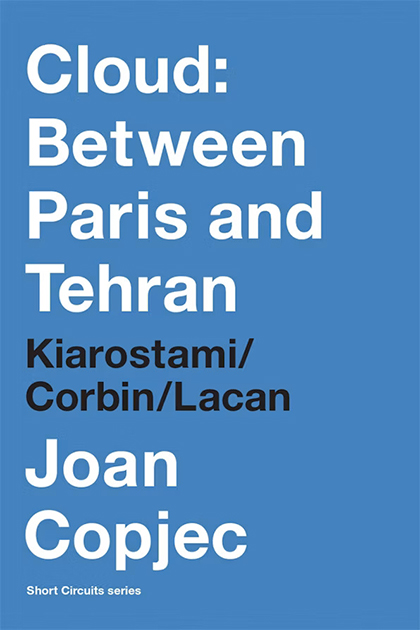
Joan Copjec. Cloud: Between Paris and Tehran – Kiarostami / Corbin / Lacan. Cambridge, Mass.: MIT Press, 2025. 208 pp.
Review by Cassandra Guan
29 October 2026
Rare are the authors who begin field-wide debates; rarer still are those who end them. Joan Copjec is one of the rarer kind. Her modus operandi is the opposite of jumping on the bandwagon: she brings the proverbial vehicle to a halt and sets it ablaze.
As a graduate student, Copjec torched the bandwagon of 1970s film theory with her essay “The Orthopsychic Subject: Film Theory and the Reception of Lacan” (1989), essentially telling the field: “Everything you have claimed about the apparatus and the gaze is wrong.” She argued that film theorists in the Parisian orbit of Cahiers du cinéma and Cinéthique had misread Jacques Lacan, taking him to be a more prodigal version of Michel Foucault and thereby losing sight of what makes representations political. When the smoke cleared, even those singed by the intellectual arsonist had to acknowledge that she was, as her friend Slavoj Žižek later put it on a book jacket, “theoretically correct.”[1]
Copjec’s long-anticipated third book, Cloud: Between Paris and Tehran – Kiarostami/Corbin/Lacan, continues to defy the gravitational pull of academic fashion. Four of its seven essays reappraise the cinema of Abbas Kiarostami through the lens of Islamic philosophy and Lacanian psychoanalysis; the remaining three are poetic non sequiturs, or “pillow shots,” that explore anxiety, shame, and their relation to sexuality (p. 13). Reading a scene from a 1979 state-commissioned documentary on education plunges the reader into recondite discussions of Henry Corbin, Christian Jambet, Steven Wasserstrom, and Ayatollah Khomeini, while presupposing extensive knowledge of Sigmund Freud, Avicenna, Ibn 'Arabi, Gottfried Wilhelm Leibnitz, and Walter Benjamin. The challenge of orienting oneself in the multiverse of late Copjec is compounded by the difficulty of knowing who this untimely book—nesting arguments about philosophy, theology, art, and history in an ever-expanding spiral of reference—is for. Such a resolutely antidisciplinary project seems downright alien in the contemporary academic publishing landscape.
This “stubbornness of a negativity” is Copjec’s special signature (p. 4). It is also what she sees, and hears, in Kiarostami’s films: from the sight that provokes existential doubt in Where Is the Friend’s House? (1987) to the sound that refuses to disclose its origin in First Case, Second Case (1979). Following the Iranologist Corbin, she argues that the most rigorous account of representational politics available to us today requires restoring to thought a dimension that modernity—in its secular, rationalist, and nominalist forms—has systematically occluded. The book’s central wager is that this esoteric dimension of being, known to Islamic Gnostic philosophers as the Cloud, names a political force essential to resisting the relentless expansion of techno-capitalist rationality.
Copjec made a similar argument when she took 1970s film theory to task for operating “a kind of Foucauldianization of Lacanian theory.”[2] What she meant is that Althusserian-Lacanian theorists misconstrued the gaze, treating it as an epistemic position from which the subject is constituted through a panoptic relation with reality. Conflating the gaze with the panoptic theory of self-surveillance reduces the subject to a function of social discourses intelligible only through dominant structures of knowledge. Against the prevailing Foucauldian model, Copjec argues that this “perfection of vision and knowledge” is achieved “at the expense of invisibility and nonknowledge.”[3] The Lacanian gaze, by contrast, is not a panoptic eye but an apophatic screen, interposing itself between the subject and any totalizing field of vision.
Reading the 1989 essay alongside Cloud reveals the remarkable consistency of Copjec’s project across three decades. In “The Orthopsychic Subject,” Copjec did not provide concrete examples of the gaze appearing in the technologically mediated field of vision.[4] What the theoretical essay establishes negatively—against the Foucaultianization of 1970s film theory—Cloud demonstrates positively through the films of Kiarostami, reintroduced by the book as a radical aesthetics born of the 1979 Iranian revolution and bearing witness to an inexistent interiority that no political or theological authority can colonize or extinguish.
Copjec’s crusade against nominalism—the view that reality is only what can be seen and measured—is not merely philosophical. It emerges from, and returns to, the revolutionary politics that shaped both her own intellectual formation and Kiarostami’s cinematic vision. For Copjec, the decisive event was May ’68, which gave rise to both 1970s film theory and the feminist movement. For Kiarostami, it was the popular revolution that overthrew Iran’s US-backed monarchy and Khomeini’s call for a new Islamic cinema to cleanse the polluted sensorium of the nation. For all their ideological differences, the ayatollah and feminist film theorists declared remarkably similar vendettas against the representational system of Hollywood (denounced by Khomeini in his Behesht-e Zahra speech as “the Shah’s cinema”), and each social movement nurtured its own political countercinema.[5] Yet Copjec accuses them of not going far enough: in her judgment, the ayatollah and the film theorists made the same nominalist error, treating the invisible as simply nonexistent and thereby collapsing the gaze into the apparatus of visibility.
Claiming Kiarostami as an ally against nominalism, Copjec maintains that the dissimulation characteristic of his filmmaking amounts to a principled stance: “Thus I refute Metz” (p.5). The greatest of his films—the Koker Trilogy, Taste of Cherry, Close Up—demonstrate that art touches reality not by what it shows or constructs, but by what it visibly subtracts. Like apophatic theology and Lacanian theory, Kiarostami’s cinema insists on the subject's irreducible opacity and stages the point at which representation fails to exhaust the reality it seeks to disclose. What Copjec defends in the singular realism of his films is precisely the esoteric dimension of reality that Lacanian theory has fought to preserve in our critical discourse.
As reality becomes ever more impoverished in the age of AI, Cloud delivers a Gnostic message: if we can awaken in time to our embodiment, we may yet abandon our suicidal goals and, like Badii in The Taste of Cherry, undergo our own resurrection—not into another world, but into this one.
[1] Joan Copjec, Read My Desire: Lacan Against the Historicists (New York, 2015), rear cover.
[2] Ibid., p. 19.
[3] Ibid., p. 17.
[4] Unless one counts as an example her reference to Lacan’s memorable appearance on French television as an example, see ibid., pp. 15, 31.
[5] Ayatollah Ruhollah Khomeini, “Speech at Behesht Zahra (The Illegality of Parliament and the Regime),” Emam.com, 12 Feb. 1978.