Critical Inquiry Critical Inquiry

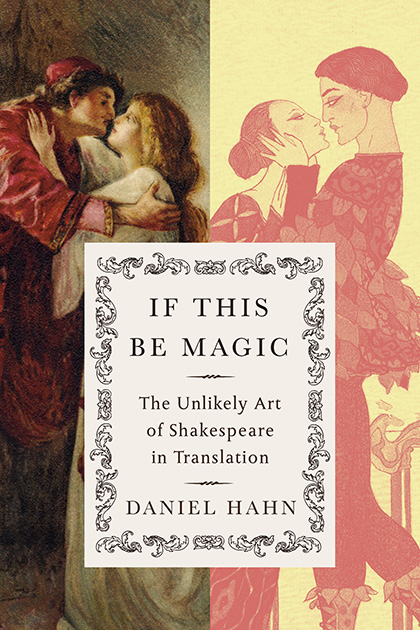
Daniel Hahn. If This Be Magic: The Unlikely Art of Shakespeare in Translation. New York: Knopf, 2026. 406pp.
Review by Chenxin Jiang
23 July 2026
Daniel Hahn’s If This Be Magic is a story about people who are constrained to take liberties with an object of piety with which liberties are not usually taken. In other words, this is an acutely comic setup. The object of piety in question is the collected works of William Shakespeare; the liberties in question are those necessitated by the act of translation. Hahn’s book dissects and discusses the translation of Shakespeare into languages ranging from Bangla to Bulgarian. Is this magic?
Literary translators are used to making the argument that a given book deserves translation. With Shakespeare, the problem is the opposite: his work is sometimes glibly described as untranslatable. Hahn, one of the Anglophone world’s preeminent translators from Portuguese, Spanish, and French, begs to differ. He considers the rendition of every element of Shakespearean verse (and prose): meter, wordplay, humor, and pronouns across multiple translations. The effect is to demystify translation—but also Shakespeare. Hahn often admires a piece of Shakespearean diction alongside the work that a translator has done to render it cleverly in a faraway context, contending that while Shakespeare’s choices are inspired, their effects can be clearly pinpointed, and others can find different words with which to achieve similar effects in their respective languages.
The ease with which the author handles a very wide range of languages reads like a magician’s flourish. Buried in a footnote on page fourteen is a tongue-in-cheek money-back guarantee from the author for any reader who knows all the dozens of languages in the book. Hahn, despite his impressively polyglot credentials, does not read all these languages, but as far as I can tell (from the ones I read), he has rendered them very accurately, instructed by the translators he interviews and by countless friends and acquaintances named in a generous acknowledgements section. And yet the sheer range of languages that Hahn includes is more than a mere party trick. If This Be Magic evinces a welcome and wholly unsubtle cosmopolitanism which is also on show in Hahn’s treatment of English as a multipolar language, as well as his accounts of non-European literary canons. He persuasively demonstrates that translation can make Shakespeare just as vivid in Farsi as in French, suggesting that no cultural distance is too great to traverse via translation.
Hahn’s premise for what works in translation sticks largely to current received wisdom: for instance, he holds that translating into a regional dialect is “from a purely practical point of view . . . distracting”—I completely agree, and so would many Anglophone readers, but this is surely in part because no successful contemporary practice and no conventions have yet emerged to support it (p. 262). But he is also a pragmatist, delighting in bridge translations (into Azeri via Russian, into Cape Verdean Creole via Portuguese) and showing how the translation of Elizabethan English into a relatively modern vernacular can, in some cases, make the meaning of the text clearer to an audience in Rio than it is to an audience in London stumbling over capons or bawds.
Hahn’s work assumes nothing—neither an acquaintance with Shakespeare nor a knowledge of any of the languages that it discusses—though it is funnier if you happen to know Shakespeare fairly well. It deserves to be widely taught in settings that have anything to do with theater, Shakespeare, reception, and translation. Perhaps even more than Hahn’s wide-ranging erudition and lucid readings of Shakespearean plays in their many versions, what I’d really like to put on a syllabus for US undergraduates is his winning enthusiasm for and sheer level of comfort with languages. He goes on indulgently madcap side quests, such as a scheme to acquire “My First Hundred Words books” in various languages (pp. 170–71). He is always pointing out some detail of rhyme or wordplay that can just about be decoded even in an unfamiliar script.
I only have a very few quibbles. In practical terms, an index of plays and languages cited would have been immensely useful. And quite impractically, I would have been fascinated by a more in-depth (though not necessarily more academic) treatment of the reception and effects of Shakespearean versions in the languages that Hahn himself has, such as that pursued by Margaret Litvin in her account of the Hamletization of the Arab Muslim political hero, or Alexa Alice Joubin’s readings of Asian Shakespeares in film. The structure of the book—each chapter considering a discreet element of the plays and describing how it’s translated into different languages—means that Hahn’s analysis has to remain largely on a linguistic and broadly cultural plane. While winsome, this format precludes the thorough exploration of many tempting rabbit holes.
The title page cheekily announces If This Be Magic as having been “written in English by Daniel Hahn.” This is, of course, making explicit a piece of magic that is often taken for granted: some books are indeed originally written in English, whereas others appear in English as if by magic, their publication having been made possible by the labor of translators who chose every word for those books in their new languages. With wit, elegance, and precision, Hahn demonstrates that if Shakespeare is translatable, so is everything else, an argument encapsulated in his reading of the statue scene in The Winter’s Tale from which the book derives its name. At a time when forms of human cultural production are so persistently shrouded in gloom, this comic rather than tragic translational take is the Shakespeare book we all need.