Critical Inquiry Critical Inquiry

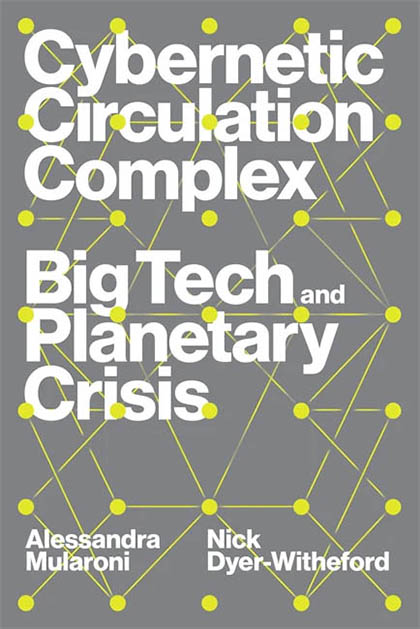
Alessandra Mularoni and Nick Dyer-Witheford. Cybernetic Circulation Complex: Big Tech and Planetary Crisis. New York: Verso Books, 2025. 208 pp.
Review by Cole Sansom
22 January 2026
Poor Circulation
At the time of writing, almost a third of United States stock market equity comes from just seven tech companies. This concentration has led writers such as Yanis Varoufakis (Technofeudalism [2024]) and Jodi Dean (Capital’s Grave [2025]) to claim we are moving towards a system beyond capitalism. Nick Dyer-Witheford and Alessandra Mularoni refute this hypothesis in Cybernetic Circulation Complex: Big Tech and Planetary Crisis, building off of Nick Srinicek’s Platform Capital (2016) and Tiziana Terranova’s concept of the Corporate Platform Complex in After the Internet (2022). They argue that Google, Meta, and their ilk have come to dominance through innovations in the realm of circulation rather than in production, or rentierism. Microtargeted advertising and instant shipping (among others) increase revenue by annihilating space and time. Commodities can be sold at the speed of light, multiplying the revenue gained from production.
In early chapters, Dyer-Witheford and Mularoni demonstrate that the collection of corporations, startups, and nonprofits that make up the titular complex have captured not only the markets but the means of value transaction: the companies that make up the CCC control payment platforms, sites where information is stored, and the infrastructure to apply that information to enhance advertising. This prevents competition and allows the CCC to dictate the rhythms of labor (such as the schedule of Uber drivers), and of the users of these platforms (who overlap with the workers). Meta will guide users towards certain news sites, Netflix towards particular viewing options, and Amazon towards certain products, all aimed toward maximizing time spent on their interfaces to continue collecting information that can then be looped back into targeted advertising.
Dyer-Witheford and Mularoni then argue that the CCC operates as a form of digital colonialism where “detailed surveillance of many countries’ online populations is held by corporations headquartered outside their boundaries” (p. 46). In its global reach, the CCC multiplies and intensifies social antagonisms—consider recent pogroms that have taken place across the globe. Potential for working-class unity against the elite is quashed by the CCC’s ability to absorb radicalism, while animus is frequently leveled towards racial or other minorities.
In their concluding chapters, the authors propose a “Biocommunism,” that would “combine elements of both social levelling . . . and degrowth” (p. 133). Cybernetics could be utilized towards allocating resources within environmental limits (including energy put towards computation). This proposal strikes as too neat, overlooking the potential for bias within the computation of distribution of resources and labor. Likewise, the book at times obscures distinctions between tech companies with significant commodity productions (for example, Apple) as opposed to ones that clearly fulfill the circulation model (for example, Meta).
These critiques notwithstanding, Cybernetic Circulation Complex’s Marxist analysis goes a long way towards answering the question that has led to those far-fetched explanations mentioned above: what is the economic principle that has led to the rapid accumulation in the tech industry that we see today? By forefronting an analysis of circulation, they indicate the path for future research to undertake.