Critical Inquiry Critical Inquiry

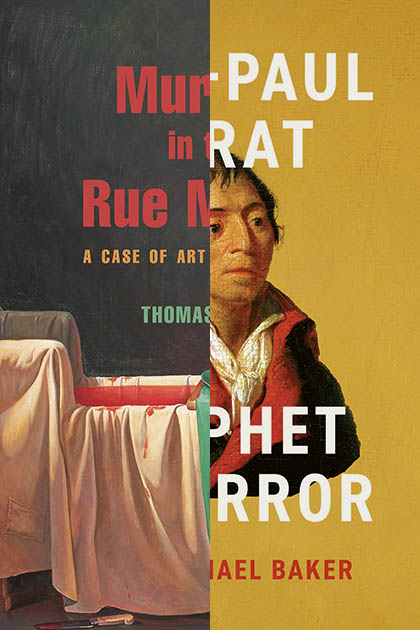
Keith Michael Baker. Jean-Paul Marat: Prophet of Terror. Chicago: University of Chicago Press, 2025. 952 pp.
Thomas Crow. Murder in the Rue Marat: A Case of Art in Revolution. Princeton, N.J.: University of Princeton Press, 2025. 176 pp.
Review by Colin Jones
16 January 2026
Jean-Paul Marat is usually adjudged the French Revolution’s most radical and bloodthirsty journalist and politician. He won lasting notoriety through ever-escalating demands for the preemptive killing of political opponents as a means of reducing overall bloodshed in the long term. In early 1790, he was claiming that massacring six hundred aristocrats and their minions would save the deaths of some five to six million patriots; by 1793, it was two hundred thousand or more counterrevolutionary deaths that could be relied on to make even larger patriotic savings. Most who condemn Marat for this grisly calculus are unaware that advocacy of this kind had a long history dating back at least to the universally admired François de Salignac de la Mothe Fénelon at the beginning of the eighteenth century, and it was endorsed by many of Marat’s peers across the political spectrum.[1] Yet revulsion at what is viewed as Marat’s signature trope has led to him being far less written about than written off as a marginal crackpot buveur de sang. Only Jacques-Louis David’s glorious image, Marat at His Last Breath, fragilely naked in his medicinal bath, the victim of assassination by Charlotte Corday in July 1793, has seemingly prevented him from sinking into obscurity.
Given many years of scholarly neglect, it comes as quite a coincidence that November 2025 sees the publication within ten days of each other of major studies of Marat, each distilling decades of research and personal reflection, by two scholars at the height of their powers. Jean-Paul Marat: Prophet of Terror by Keith Michael Baker, long the doyen of US historians of ideas working on the French revolution, is a classic intellectual biography that accompanies Marat from cradle to grave, and in so doing rehabilitates as a serious political thinker a figure too often regarded as merely “the poster-boy for slaughter” (p. 563). In contrast, the highly distinguished historian of art, Thomas Crow, gears his Murder in the Rue Marat: A Case of Art in Revolution towards reflection on the historical resonance of Marat the man and David’s image of him. Both Baker and Crow emphasize the timeliness of a reassessment of Marat for current times. Yet they differ radically as to what that timeliness consists in.
Long awaited, Baker’s Marat is a towering monument of erudition and sane, balanced, and insightful scholarship. Baker views the full range of Marat’s copious philosophical, political, medical, and scientific writings throughout his life as the product of a rational rather than a clinically disordered mind. He follows Marat’s thought and action along the daily flow of events, starting with his itinerant, mildly picaresque early life. “My aim,” Baker states, is “to make sense of Marat’s actions, monstrous or not, by bringing into relief the words he used to express his conception of self, diagnose his world, and frame his goals” (p. 5). It is worth noting that Marat never wielded power in any conventional sense, and although he is often attributed a major part in the heinous September Massacres of prisoners in Parisian gaols in September 1792, his role was probably confined to cheerleading for the killers. (Though as Baker sagely notes of this sanguinary episode, monstrous words can still bear some responsibility for monstrous events [see pp. 575–76].)
Baker’s reevaluation of Marat is notable for highlighting the critical importance of the years that he spent as a young man in England during the 1760s and early 1770s. Marat had an early interest in medicine, using his time in England to profit from its much more open medical marketplace to experiment with new forms of treatment, and he proved adept at building up a monied clientele. Starting in London, he also dedicated an increasing amount of his time to serious scientific experimentation. Marat thought big and loved a challenge, but serially bit off more than he could chew: he assailed Isaac Newton, patron saint of Enlightenment science, for his writings on optics, Antoine Lavoisier for his work on fire and gases, and Benjamin Franklin for his writings on electricity. The predictably huge mountains of venom piled on his scientific presumption gave him a lifelong aversion to any form of authority as well as a reputation for charlatanism that was not, Baker judges, altogether fair. Yet, as he admits, Marat’s self-promoting style—he was forever congratulating himself on his own genius—was hardly in the style of the age’s gentlemanly science. Marat was no gentlemen of science. Nor, as Baker amply shows, was he a gentleman in politics.
England was the site of Marat’s political apprenticeship as well as his early scientific explorations. He viewed England’s representative system as a sham and indeed, by dint of its complicity with political corruption, a scam. He was present in London for the John Wilkes affair (1769–70) to observe at close hand the popularity that the louche English adventurer and political reformer gained. He saw how journalism, as practiced by Wilkes and by the anonymous author of the tirades in the Letters of Junius (1769–72), could deploy the power of denunciation as a means to rouse public opinion.
Marat came to the Revolution in France having imbibed English lessons. Unlike fellow revolutionaries like Maximilien Robespierre whose political ideas were filtered through Greco-Roman antiquity, Marat drew on the politics of distrust and denunciation that he derived from the English radical tradition. His first political work, The Chains of Slavery, published in English in 1774, invited English voters to overthrow the despotism exercised over them by their would-be representatives in Parliament. The message he promoted in Paris once the Revolution got under way was much the same. For Marat, the summer of 1789 had seen not the triumph of Revolution but its débâcle. Instead of shutting the established orders of the nobility and the clergy out of the political process, commoner deputies had allowed them to take a place alongside them in the National Assembly. In so doing, the would-be representatives of the people had betrayed the people. He thus welcomed popular violence, as it showed that the people were awake and active in their own collective cause. He would see the overthrow of King Louis XVI in the revolt of 10 August 1792 as just as much a condemnation of the so-called “representatives of the people” in the national assembly as a rejection of monarchy.
Such was Marat’s bloodcurdling reputation for violence, and so consistently offensive his attacks on elected deputies, that his decision to stand for the new National Convention in the autumn of 1792 must have seemed breathtakingly out of character. Once elected, Baker suggests, he struggled to adjust to this new identity and reality. He was a fish out of water, scorned as “a party of one,” with even political allies keeping him at a prudent distance (p. 662). He was outmaneuvered and outshone by more able political operators on the Left such as Robespierre, while outside the assembly he was outflanked by the new breed of Parisian sans-culotte radicals who stressed economic issues in ways he never had. By July 1793, he was on the way to becoming an extinct volcano, with most of his political capital either used up or repackaged by others. By then, he was also extremely sick and close to death even before Charlotte Corday came calling.
Baker concludes that Marat was a “prophet of terror,” in that the anti-elite politics of distrust that he had preached even in advance of 1789 had by 1793 been largely adopted as the program for what came to be called the Great Terror of 1793–94. Any credit that accrued to him after his death was, however, short-lived. The Right applauded his passing while politicians on the Left, who had found him an uncomfortable ally, preferred him dead so they could sanctify him as the sacrificial victim of elite violence. Created on government orders and first exhibited in the Louvre in October 1793, David’s masterpiece, “one of the most iconic paintings of the Western artistic canon,” as Baker calls it, was thus merely a flash in the pan (p. 4). Such was the obloquy heaped on Marat’s name following Robespierre’s fall that David’s students were obliged to conspire to keep the painting hidden and out of harm’s way for more than a generation.
As well as being a “prophet of Terror,” Marat was also, Baker holds, “the first modern populist,” “a thinker for whom the people as a body existed as the ultimate and essential political reality. The people embodied, rather than the nation represented, was the ground of his political ontology” (pp. 6-7). Applying to the French revolution a term coined only in the late nineteenth century—and which has had and continues to have a stormy and contested history—raises a host of issues about the genealogy of populism before our own times. Understandably, Baker steers clear of answering the biggest and most burning questions that his conclusion pushes us to address.
Interestingly, Baker’s interpretation also runs counter to Crow’s sparkling study, in which the author seeks to “reconnect [David’s] painting with the lives of its creator and his subject” (p. 24). In its way, Murder in the Rue Marat is a quest to de-diabolise Marat: Crow presents him less as the draftsman of the Terror than as the hero of the disenfranchised people and the oracle of resistance to state violence. Marat’s spectral presence, Crow suggests, has reinvaded the political scene at key moments of democratic challenge. In the 1830s and 1840s, he posits, the painting’s reappearance (in Belgium, where it currently resides) and revaluation reflected the reemergence of the democratic impulse in French politics. Then, closer to home, the 1960s and 1970s witnessed further Marat appearances in the counterculture of those decades, to which Crow adds his personal testimony.[2]
Presuming that a linear narrative would not suffice to contain the richness of the image, Crow adopts a methodology he derives from S/Z, Roland Barthes’s 1970 analysis of Honoré de Balzac’s short story “Sarrasine,” which involves using the formal properties of the painting as jumping-off points for discussion of wider cultural and political resonance. Thus Crow links the division of the painting into two starkly contrasting upper and lower halves to an earlier painting of a pietà by David’s pupil Anne-Louis Girodet de Roussy-Trioson in ways that afford the painting a religious sheen that can be set in the context of the wider politico-religious theme of martyrdom. As Crow notes too, the painting is as suggestive in what it leaves out as what features on the canvas. The murderess Charlotte Corday is prominent only by her absence, allowing Marat’s martyred body to remain front and center: idealized, spiritualized, and indeed softly degendered, with only insignificant specks visible of the blood in which the murder scene would have been awash. Crow evokes the sans-culotte cry at the time of Marat’s funeral, “Marat is not dead” (p. 46). And in David’s telling, Marat did indeed possess two bodies, one biological and the other sacralized, embodying the people oppressed, resistant, and perennially present as long as social injustice exists in the world.[3] Reading these two fine works together multiplies the pleasurable if conflicting inspirations to which each gives rise, and it also leaves us much to ponder amidst current preoccupations and discontents.
[1] For the Fénelon point, see Michael Sonenscher, Sans-Culottes: An Eighteenth-Century Emblem in the French Revolution (Princeton, N.J., 2008), p. 218. For a counterrevolutionary perspective, see The Letters of the Duchesse d’Elbeuf: Hostile Witness to the French Revolution, ed. Colin Jones, Simon Macdonald, and Alex Fairfax-Cholmeley (Liverpool, 2024).
[2] See Thomas Crow, The Artist in the Counterculture: Bruce Conner to Mike Kelley and Other Tales from the Edge (Princeton, N.J., 2023).
[3] See Ernst Kantorowicz, The King's Two Bodies: A Study in Mediaeval Political Theology (Princeton, N.J., 1957).