Critical Inquiry Critical Inquiry

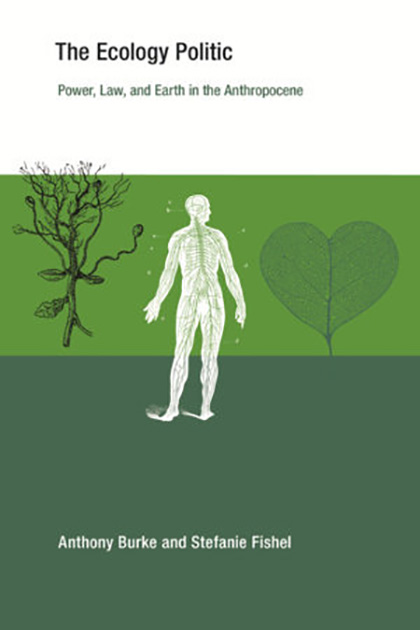
Anthony Burke and Stefanie Fishel. The Ecology Politic: Power, Law, and Earth in the Anthropocene. Cambridge, Mass.: MIT Press, 2025. 307 pp.
Review by Dipra Sarkhel and Dibyendu Sahana
23 April 2026
It has been over a decade since we began to ask whether a political imaginary rooted in state sovereignty, territorial boundaries, and an Enlightenment faith in progress can survive the century’s climate emergencies. In countless conferences and seminars on global governance, the refrain has been that our best hope lies in tweaking existing institutions. But in the midst of mass extinction, geoengineering schemes, and climate migration, such limited reform increasingly appears to be an evasion of the real stakes of the matter.
Anthony Burke and Stefanie Fishel’s The Ecology Politic: Power, Law, and Earth in the Anthropocene refuses that evasion. From its opening chapters, the book makes a decisive break with the ecology of separation embedded in modern political thought (separation of human from nonhuman, of state from ecosystem, of sovereignty from the material conditions that sustain it), instead advancing an ecology of connection grounded in interdependence, mutual vulnerability, and the inseparability of human and nonhuman fates. It is a project at once genealogical—tracking how political modernity severed the human from the earth—and constructive, offering an “‘environmental constitutionalism’” that seeks to reorder the very foundations of governance (p. 134).
The method here is both theoretical and programmatic. Drawing on political theory, international relations, Indigenous philosophies, and environmental law, Burke and Fishel move fluidly between histories of Westphalian sovereignty and proposals for planetary-scale institutions capable of protecting the biosphere as a subject of law. Like the best work in critical environmental politics, The Ecology Politic keeps scale in play: from the micro-politics of everyday ecological care to the macro-politics of rethinking the UN Charter. This interplay recalls the oscillations in the environmental humanities between close, situated attention and speculative global architecture.
If the book’s normative ambition—nothing less than a constitutional refounding of the global order—seems utopian, its critical force lies in exposing the bankruptcy of incremental reform. The ecology of connection is not offered as a metaphor but as a concrete political principle, one that unsettles the anthropocentric liberalism underpinning current environmental regimes. At times the vision risks abstraction, particularly when moving from critique to the institutional blueprints of a “Earth System Council (ESC)” (p. 129). Yet even here, the authors’ refusal to dilute their proposals into technocratic manageability is precisely the point: survival in the Anthropocene demands political forms adequate to the planet’s material interdependence.
By the final chapter, the book’s wager is clear: that constitutional orders can be reimagined so that the flourishing of ecosystems is not a derivative policy aim but a constitutive value. Whether or not one shares their optimism, Burke and Fishel compel us to think beyond the self-imposed limits of political possibility. In a moment when ecological governance is too often reduced to the art of the minimally possible, The Ecology Politic insists that our survival hinges on rethinking the impossible.