Critical Inquiry Critical Inquiry

Joyce Suechun Cheng: The Persistence of Masks: Surrealism and the Ethnography of the Subject. Minneapolis: University of Minnesota Press, 2025. 228 pp.
Review by Jacob Stewart-Halevy
19 February 2026
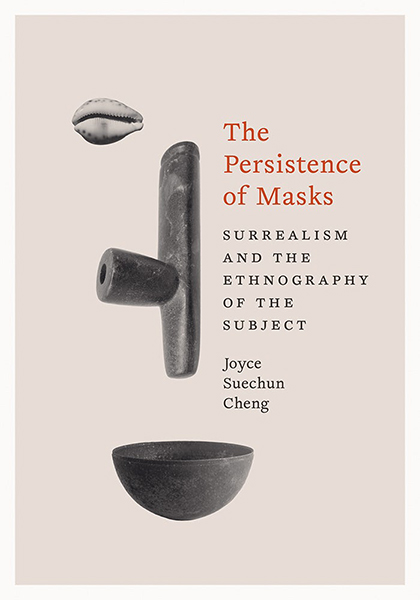
The Persistence of Masks locates a shift in surrealism during the early 1930s away from a liberatory art of lucid dreaming toward a “mature automatism,” which registered creeping totalitarianism and the implosion of the bourgeois public sphere (p. 95). Sifting through images, essays, field notes, and theoretical tracts, Joyce Suechun Cheng discovers the movement’s iconography of “masks,” which act as a kind of carapace, alternately protecting and disclosing the surrealist subject. If iconography traditionally identified saints through their attributes, the method is employed here to untangle subjects from their guises. The author means physical masks but also bodily appendages like hands, ears, hair, and skin; adornments including hats, veils, and cloaks; and decorative motifs, especially the petrified tendrils and whiplash lines of art nouveau that so captivated the surrealists. These motifs play an important role in strategies of masking, which enclose and subdue as much as peel away and flay layers of subjecthood, in contexts that stretch from the pages of key journals to fictional encounters on the streets of Paris and, ultimately, to trance and dance in Rio De Janeiro and Northern Ethiopia.
Through eclectic—yet considered—cases, the book intervenes into longstanding debates around the antinomies of Surrealism. Cheng argues that divisions between its idealist and dissident camps, represented by André Breton and Georges Bataille respectively, have been overblown, highlighting instead the rapprochement between the two figures while tracing moments of synthesis in Salvador Dalí, Tristan Tzara, and above all, Michel Leiris. The study tends toward minor histories: not Dali’s dreamscapes but his collages and notes; not Tzara’s manifestos but obscure meditations on the gendering of hats; not Leiris’s self-reflexive Phantom Africa (2017) but his sober fieldnotes on Zar possession.[1] Cheng analyzes the early Jacques Lacan, whose notions of paranoid psychosis proved crucial to the surrealists rather than the more canonical Lacan, whose argument for the linguistic structure of the unconscious and exegesis of the connection between metaphor and condensation and metonymy and displacement became shibboleths of psychoanalytic art history. In fact, in the author’s reading, “the metonym” is “a particular kind of metaphor,” a suggestive and contradictory notion that plays out through close readings of works that confuse contiguity and doubling such as the manipulated photographs of Raoul Ubac, who “reintegrates the mirror reflection into that of the shadow” (pp. 33, 131).
Detailed analysis of the intellectual currents of the early 1930s make the case for a more capacious ethnographic surrealism, the term anthropologist James Clifford used to describe how the surrealists employed the aesthetics of collage to undermine the fixity of roles between ethnographers and their research subjects under conditions of colonial domination, thereby prefiguring the writing culture turn in his own discipline.[2] Cheng mostly sidesteps Clifford’s aesthetics of juxtaposition that confuse self and other, opting instead to explore how masks allow subjects to phenomenally and “para-ethnographically” relinquish sovereignty over themselves (p. 7).
In this sense, the book dovetails with currents of poststructuralism that were obscured amid the distinctive reception of Bataille by art historians in previous decades. Her reading of dispossession hews more closely to the somewhat forgotten phantasms and tensors of the Libidinal Economy tradition, where —pace Jean-François Lyotard and Pierre Klossowski—the mask functions as a simulacrum, reproving itself yet tracing the edge of what it dissimulates all the while. Far from nihilistic conclusions about masks all the way down, Cheng sees the trope as enacting substitutions for social and political ends. In Dalí’s collage The Phenomenon of Ecstasy (1933), the isolated and repeated ears of criminals become simulacral genitals, their floral, vaginal form moves the viewer oneirically into the terrain of the “universal-feminine” (pp. 105, 133). One of the book’s leitmotifs, the term revises longstanding assumptions about Surrealism’s phallocentric misogyny while drawing contrasts to the aesthetics of “aggressive rigidity” at the surrealist fringe, where Roger Caillois explored masks of catatonic dispossession—the decapitated praying mantis who still plays dead—while other affiliates of the College of Sociology dabbled in cryptofascism (p. 125).
The final chapter on surrealist ethnography finds a way out of this assimilation to the inanimate. Rather, turning headlong toward the animate, Cheng surveys Leiris’s writings on Zar rites. Here, politically and economically disenfranchised women dance—and become danced—into a state of delirium by the spirits that drive them. Where anthropologists have read such rituals as a means of reinforcing social discipline, initiating rites of passage, communing with spirits, and much else, Cheng focuses on the zarine, Malkam Ayyahou, who used her masks as “a wardrobe of personalities” to strategically displace the intentions and effects of her performances onto a shifting cast of projected characters (p. 140). Her reading, whereby the uncanny mask serves as canny political maneuvering, echoes social constructivist currents of performance and persona studies; yet one wonders how the author’s invocation of the universal feminine here might be grounded in the linguistic dimensions of Zar practice. In Moro, for instance, the unmarked plural default is coded feminine within the patriarchal community in which it is spoken. The issue speaks to a dialectic that unfolds throughout the book between the unique aesthetic displacements of artist-figures like Ayyahou and the mask’s function within the public and collective constraints of the masquerade broadly conceived. This productive tension often yields a less individualistic and more folkloric surrealism, deftly revising the movement’s key concepts and concerns. The book promises to spur debate in one of the more vibrant areas of historical avant-garde studies, therefore, especially given that many surrealism scholars double as practicing late-surrealists, suggesting that it is not just the masks that persist but the movement itself.
[1] See Michel Leiris, “Le culte des zârs à Gondar (Éthiopie septentrionale),” Aethiopica 2, no. 3–4 (1934): 96–103, 125–36.
[2] James Clifford, “On Ethnographic Surrealism,” Comparative Studies in Society and History 23 (Oct. 1981): 539–64.