Critical Inquiry Critical Inquiry

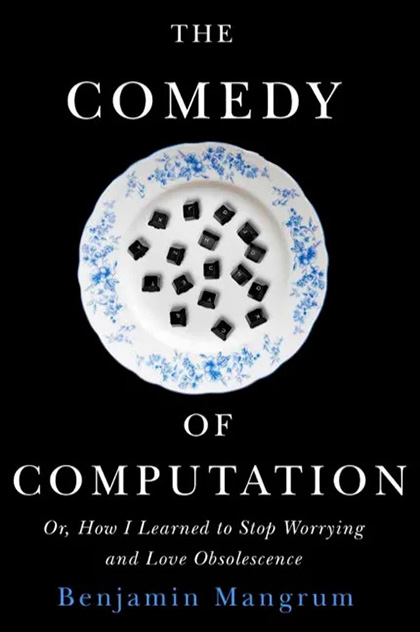
Benjamin Mangrum. The Comedy of Computation: Or, How I Learned to Stop Worrying and Love Obsolescence. Stanford, Calif.: Stanford University Press, 2025. 276 pp.
Review by Kate Marshall
16 April 2026
It’s easy to feel guilty about finding anything related to the world of automation funny, now or in its history. I live next door to one of the world’s largest data centers, which seems by most accounts to be uninhibited in its rampaging of the groundwater and local electrical grid, and I talk regularly with new and temporary neighbors drawn to an unforgiving climate by the demands for its construction. And yet, the absurdities of our computational moment exert a tremendous pull, and my cultural tastes on this topic are far from limited to the dystopian.
Benjamin Mangrum’s The Comedy of Computation: Or, How I Learned to Stop Worrying and Love Obsolescence explains why that might be. It provides a clear and culturally rich account of why comedy has been and continues to be central to our experience of the contradictions of computation since the mid-twentieth century. Late in the book he unpacks the compensations of comedy in an age of growing anxiety over automation: if comedy is what we want, he says, this may signal a desire for “some pleasure and happiness in an unfunny world” (p. 197).
At the heart of Mangrum’s study are the comedic genres that provide the infrastructure for navigating the moment where anticipation of the future collides with obsolescence, or the feeling of being behind. In these cultural encounters with computation, we see how the social itself is constructed. Mangrum shows early in the volume how a range of tropes and approaches to genre (genericness) are crucial to understanding the story of technology since mid-century and then moves to examples including satire and the absurd.
A central chapter on the genre forms surrounding the “couple” and computation is a showpiece of the book. Mangrum lavishes much deserved attention on The Desk Set (dir. Walter Lang), first a play and then a 1957 film starring Katherine Hepburn and Spencer Tracy. Couples are generic, both in the terms Mangrum outlines governing mid-century comedy, but they also become in this account a way to transform a genre oriented towards happiness narratives with information management technologies. Computation exists in these spaces as an avatar both of managerial bureaucracy and a source of personal or even erotic satisfaction.
Mangrum is no stranger to the varieties of comedic form, and he supplements this sensibility with a playful table of contents modeled on Friends, and justifies the titular nod to Dr. Strangelove with an updated reading. At times, I hoped for more such moves and play—the “I” of the subtitle emerges briefly in the front and back matter—but in its brevity this is also, generically, a missed opportunity.
We know from texts like Amitav Ghosh’s The Great Derangement (2016) that genre is one of the great tools cultural critics have to understand complex problems like climate change, and computation-driven automation is another such category. Mangrum’s book makes a convincing case for comedy as central to the genre story that will in turn be central to our understanding of the current era of computational technology as it continues to develop in the coming decades.