Critical Inquiry Critical Inquiry

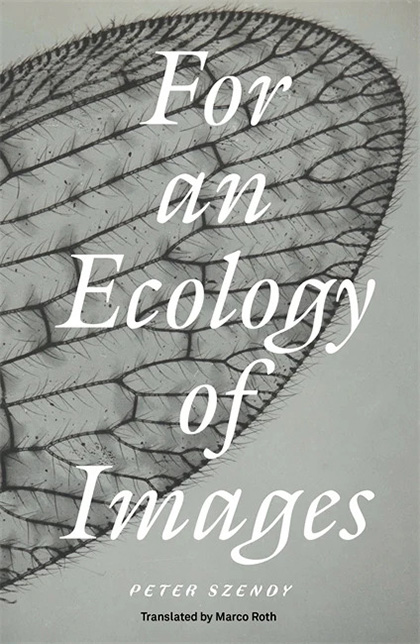
Peter Szendy. For an Ecology of Images. Trans. Marco Roth. New York: Verso, 2025. 112 pp.
Review by Kyle Sossamon
28 May 2026
“Ecology,” Szendy writes, delineates “a new attention to time” and marshals an awareness of “all the divergent and dissonant temporalities that work within, through, and around images” (p. 9). Decentering the human is the prerequisite for such an endeavor, since the anthropos anchors our temporal horizon to the teleology of human utility and self-interest. An ecology, then, for Szendy, expands our collective horizon for considering alternative timescales: discordant temporalities, their paradoxes, and how these define a shared lifeworld.
But are images not the premier example of an existence for the human? From Plato to Guy Debord, the image is an appearance, a phenomenon that comes into view (that literally comes forth) as significant for the contemplative mind (even if Plato and Debord would disagree vehemently over the project of contemplation). Our concept of theory, even, has its etymological roots in visualization, in spectacle (theōria). How can one conceive of an image regime (an “iconomy,” as Szendy has it), that not only decenters the human but is truly autonomous?[1] And, more importantly, how can one scrutinize this iconomy without reducing the image as such to an ideological epiphenomenon?
To propose an ecology of images as a project of theoretical inquiry, therefore, Szendy must find an alternative lineage of interlocutors who unapologetically grant imagery a vital ontological status. But before doing so, he must also explain how contemporary imagery necessitates, and justifies, such a turn.
This ecology, then, presupposes at least two novel developments in the production and circulation of imagery in contemporary visual culture. First, that images are now primarily acheiropoetic (p. 29). The term comes from the Christian tradition in which certain icons were considered to be miraculous in their production, that is, not made by human hands—the Shroud of Turin being, perhaps, the most well-known example today. For Szendy, this term is worthy of retrieval not because of its connection to divinity per se but for its evocation of an invisible process of visual emergence—one not dissimilar to the emergence of natural imagery, as we will see. In step with a line of inquiry relentlessly pursued by contemporary American artist Trevor Paglen, Szendy “aims” to render visible the “amplitude and density,” the “temporal tonalities in the midst of the billions of snapshots that our social networks ferry every minute, within milliseconds, from one end of the world to the other, where they vanish almost as soon as they appear, swallowed in the flux” (p. 10).[2] That is, contemporary imagery exists only momentarily for human vision, but it insists without our attention constantly and discreetly as machine-readable code, as files of informatics, crisscrossing the globe at rates of speed that would send Paul Virilio reeling. This, then, is the second development: if an image on your phone appears as an image fleetingly—only when you open it—before returning back to its machine-readable form, then what is the novel temporality of this coming-to-presence, what is the “speed” of this “transit” from discrete packet of data beyond the human sensorium as “they condense and coagulate and take shape” acheiropoetically before your eyes (pp. 24, 25)? Images worthy of an ecology, then, first and foremost, possess a “heterochronicity”—“either an anticipatory or postponed development”—irrespective of our concern for them (p. 42). This “self-differentiation” within contemporary imagery as they pass from invisible to visible and back again must be explained ontogenetically (p. 60).
Such is how Szendy decenters the human in the historical realm of appearances: by turning to a tradition of thought and engagement with images whose status as visible is the result of processes indifferent to—and largely concealed from—human purposes. What is principally at stake, then, for Szendy is “the time of appearance itself, as it differentiates” today (p. 104).
Szendy appeals to a specific lineage of thinkers in order to think through this “iconogenesis”: Georges Bataille, Roger Caillois, and Gilbert Simondon (p. 38). From Bataille, Szendy borrows the concept of a general economy, one predicated on abundance and waste as an aneconomic principle of squandering, opposed to scarcity. The insight Szendy pulls from this principle of excess concerns the idea of “images for nothing,” those images that are “lost to sight”—or, invisible as excess (p. 76). This invisible excess mirrors Caillois’s sense of mimicry as a useless expenditure, an opulence of simulacra whose circulation promotes nothing more than its own continuance. Via these two figures, Szendy transposes imagery as it relates to an excessive invisibility in nature (as a principle of production in Bataille and circulation in Caillois) into the counterintuitive domain of acheiropoetic technical imagery. From Simondon, Szendy takes the ontogenetic process of self-differentiation that the former ascribes to the vitality of all “natural images” (p. 60).
Across these three figures, a core theme arises: contemporary “invisible visual culture,” to borrow Paglen’s phrasing, empirically vindicates the tension (the literal ontological splitting) of the image as an aneconomic (“aniconomic,” for Szendy [p. 104]) excess of temporal expenditure. Images are not the products of this economy, the consumable goods, but its frozen residue, springing forth from the elasticity of a temporal process whose anoptical insistence is its ecological significance. Technicity, in other words, borrows from a divinatory tradition in more ways than one. No longer a Shroud of Turin, then, but a cloud of icology.
[1] Peter Szendy, The Supermarket of the Visible: Toward a General Economy of Images, trans. Jan Plug (Fordham, N.Y., 2019), p. 4.
[2] See Trevor Paglen, How to See Like a Machine: Images After AI (New York, 2026).