Critical Inquiry Critical Inquiry

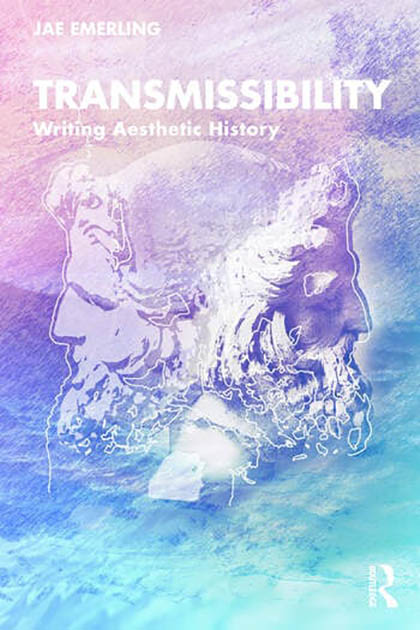
Jae Emerling. Transmissibility: Writing Aesthetic History. New York: Routledge, 2023. 166 pp.
Review by Kyle Sossamon
5 February 2025
A “Twombly-effect” (p. 82)? Jae Emerling quotes a young Cy Twombly from L’Esperienza moderna: “for myself the past is the source (for all art is vitally contemporary)” (p.78). This is the crucial tension lying at the heart of Emerling’s latest text: the contemporaneity of a past whose sense lies on the horizon, needing to be transmitted in a work yet to come, as Paul Klee might have it when addressing the distinctly “modern” in modern art.[1] Following a line of thought (flight?) traced by Gilles Deleuze and Felix Guattari, yet enmeshed with insights from thinkers as diverse as Walter Benjamin and T. S. Eliot, Emerling approaches the task of the historiographer as being identical with a charge of fidelity to the event (see pp. 31–32). But these events—and this fidelity—are far removed from the aesthetic protocol of an Alain Badiou, even if the latter would certainly appreciate Emerling’s insistence on the ontological dimension of art’s historicity.
The past is, and the task of the historian is to betray that immediacy by ushering it onward in time and translating it for future readers who will only know it differently than the historian who sent it forward. There is an irremediable creativity that marks this kind of experimentation, and this is what Emerling attempts to put on display. Making art writes history, and writing history makes art. Ontology and aesthetics are imbricated to such a degree that their apparent division is entirely actual—but certainly not virtual—which is why Deleuze famously argued for a counteractualization of sense-events.[2] Artworks and works of history alike can combat the imposed linearity of causal procedures with the nested ideas of progress, teleology, and divinity that weigh down the emergence of novelty only by remaining attuned to the retroactive relation that the future maintains with a contemporaneous past: meaning is constructed after the fact and in the moment.
Emerling’s encounter with Giorgio Agamben over the temporality of “tradition” is perhaps where the text shines brightest (pp. 130–38). Picking up on Benjamin’s eschatological reading of Klee’s Angelus Novus, Agamben’s analysis of the state of art (and its history) is one of melancholic suspension: we moderns await a final judgment, one that will never come, in an age of alienated homelessness where works of art testify to our dislocation, and works of history bear witness to an irrevocably severed link with a past that once maintained an organic and continuous connection with the present. Fanning the flames for an impossible return.
Emerling’s account of transmission, alternatively, asserts a discontinuous tradition that must be continually de-created (“neither a negation nor a return to an uncreated state” [p. 32]) and rendered anew in order to become otherwise, that is, in order to survive. Twombly’s work returns here critically. Whether Second Voyage to Italy from 1962 or Hero and Leander (To Christopher Marlowe) from 1985, Twombly relentlessly encounters a past whose variation is the product of repetition. But these “are repetitions that generate effacement and complication rather than citational clarity,” reproductions of the same or dialectical unities (p. 80). Twombly “deframes the historical present” by recomposing familiar content with novel forms that neither induce a strict ostranenie in the viewer, nor generates readymade insights; rather, problems are produced indefinitely and infernal questions are raised that beckon prolonged and repeated reengagement (p. 82). An encounter with Fifty Days at Iliam impels us to ask what power a proper name holds in a mutable record of time. Not who, but when is Achilles? How does singularity merge with the transhistorical? Emerling shows how the work of transmissibility itself produces only provisional answers to such questions in the flux of experimentation. Such is its strength.
[1] Paul Klee, “On Modern Art,” in Modern Artists on Art: Ten Unabridged Essays, ed. Robert L. Herbert (New York, 2001), pp. 103–115.
[2] See Gilles Deleuze, The Logic of Sense, trans. Mark Lester and Charles Stivale, ed. Constantin V. Boundas (New York, 1990), p. 178.