Critical Inquiry Critical Inquiry

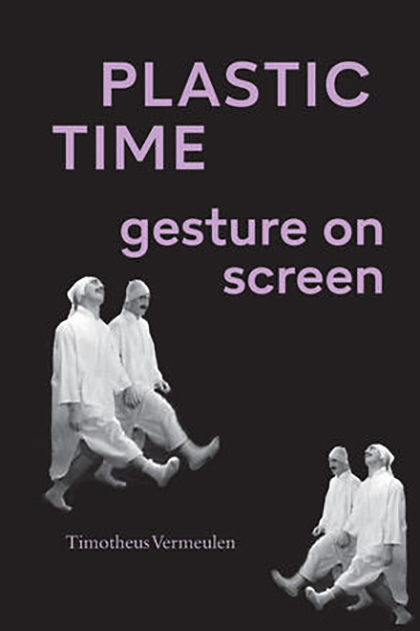
Timotheus Vermeulen. Plastic Time: Gesture on Screen. Albany, N.Y.: State University of New York Press, 2026. 201 pp.
Review by Kyle Stevens
6 November 2026
In a way, Timotheus Vermeulen’s point in Plastic Time: Gestures on Screen is simple: gestures tell stories, and stories condition, and are conditioned by, narrative temporalities. But that certainly does not make the point trivial. “The gesture can pitch a body, a subject, a scene, and even a world into a tense aspect or mood. It can turn time around and keel it over, making it lean into the future,” he writes, “or it can pull it back, bending it backward into the past” (p. 113). For Vermeulen, figures on screen are not acted upon by time but, rather, “the image (the form) of time is always intrinsically corporeal, intimate, a malleable quality of a character’s bodily expressions and gestures—as plastic, indeed, as the movements of the actors’ bodies” (p. 5). Vermeulen thus invents a way of seeing screen gestures that suggests the audience occupies a position similar to the readers of “writerly” literature described by Roland Barthes.[1] For reading a gesture is a task undertaken not to complete the text but to open up ways of imagining possible completions, a creative process that must continually reinvent its own conditions to meet the demands of the figure encountered.
Interpreting gesture is therefore a political act, and, fittingly, there are no botoxed brows quarantining high and low culture here. This fact, combined with his capacious view of gesture—it includes physical movements ranging from facial expressions to pantomime—allows Vermeulen to select a range of case studies across mainstream and experimental cinema, music video, and television precisely to demonstrate the durability of his method. Implicitly drawing on a Germanic philosophical tradition, and particularly on ideas of gesture from Walter Benjamin (whose name pops up occasionally), gestures here are not simply reactions or responses to context nor do they occur within time if time is conceived as a series of moments to be filled. Rather, Vermeulen argues that gesture creates time or, perhaps more accurately, timelines. For example, he observes that Rick’s (Humphrey Bogart’s) tipping of Ilsa’s (Ingrid Bergman’s) hat in Casablanca (dir. Michael Curtiz, 1947) is an anticipatory gesture, thus suggesting a potential future time: “Rick’s gesture does not reproduce a temporal regime that already exists (his circular cynicism, say, or Ilsa’s introspective spiraling), but resets the time, literally redirecting Ilsa’s gaze elsewhere: up, ahead, forward” (p. 36). Conversely, Donald Glover’s style of dancing in his music video This is America (2018) directs attention to the past, invoking a history of racialized violence. Or, in the 1950s family sitcom Father Knows Best, Elinor Donahue’s stubborn agitations create temporal impasses in the narrative that troubles the show’s purported gender normativity. Gestures can even shift us outside of time. For instance, Vermeulen argues that Alexis Bliedel’s awkward hugs in the TV series Gilmore Girls (2000–2007) betray an anxious teenager’s temporal unworldliness.
Particularly helpful about this book is Vermeulen’s novel approach to studying screen characters and performance. Interpretations of actors’ efforts and characters’ movements occur across topics and can be found in studies of authorship, genre, realism, psychological realism, national traditions, adaptations, and more. Such consideration tends to happen via close readings, looking at how the onscreen figure functions within the context of a scene (or across scenes, films, and so forth). Vermeulen, however, inverts that model, generating a new perspective in order to elucidate how the specificity of a gesture creates context. “The gesture doesn’t signify,” he explains, “it qualifies” (p. 44).
I often say that one has not fully thought through a subject until one bangs up against the wall of prepositions. Which are correct in this context? If there is an aspect of Plastic Time that may at first appear confusing, it is its evolution of prepositions. Vermeulen situates gestures in time, of time, and through time—he asks what they do for time until at last, in the final sentence, the “gesture is time” (p. 167). These shifts are not a weakness, as each phrase in its context is accurate. In fact, they are a testament to the arc of the book and to its central argument. Taking up Vermeulen’s view, gestures establish the grammatical tense and, so in part, the syntax of what we see and hear. Hence, anyone interested in the meaning-bearing structures of media will find great worth in Plastic Time.
[1] See Roland Barthes, S/Z, trans. Richard Miller (New York, 1974).