Critical Inquiry Critical Inquiry

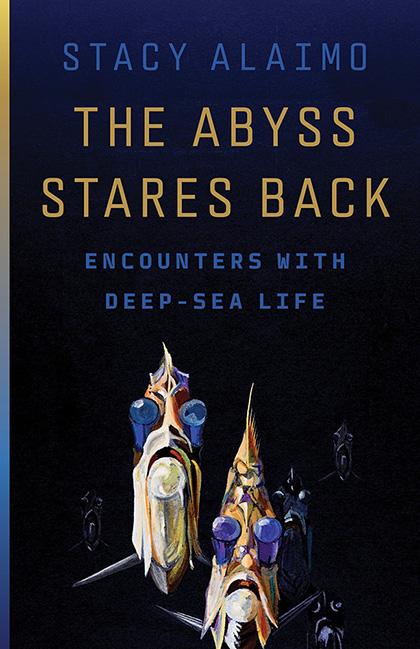
Stacy Alaimo. The Abyss Stares Back: Encounters with Deep-Sea Life. Minneapolis: University of Minnesota Press, 2025. 251 pp.
Review by Lawrence Buell
15 May 2026
Dare one hope that images of strange creatures of the deep that very few people will ever see, that inhabit places where almost nobody will ever venture and few even think about, can energize concern and activism against the systematic exploitation of ocean’s resources, even when the imaging processes themselves depend on those same institutions of capitalism and colonialism to fund the efforts to reach, record, and circulate them? That is the heart of Stacy Alaimo’s inquiry in The Abyss Stares Back. The book answers with a cautious maybe.
Alaimo is a seasoned environmental humanist, author of three well-regarded previous books, best known for her influential theory of “trans-corporeality,” meaning, roughly, the porousness of human bodies and their environmental surrounds.[1] The Abyss Stares Back is her first major sortie into the burgeoning subfield now called the “blue humanities,” humanistic scholarship focused on the discourses of oceanic spaces and the endangerments to those spaces, gravest among them being deep-sea mining, which is lethally disruptive to the species considered here and the millions more still undiscovered by science.
As such, The Abyss Stares Back might be said to offer a kind of limit case for ecocritical studies in at least two semi-related ways. First, in its assessment of the possible capacities—and overreach—of the creative word and image when directed far beyond familiar, easy-to-empathize-with cases like polar bears on shrinking ice floes to the domain of beings scarcely recognizable by humans as fellow creatures—creatures as susceptible to fantasy projection as space aliens, Alaimo points out. Second, in the sophistication of the book’s critique of how image-taking and dissemination become entangled with the institutions of exploitation. Deep-sea imaging is costly and disruptive to marine environments in ways the images occlude. To undertake it requires collaboration with groups whose interests are mainly commercial. It caters to a romance of the exotic other that is easily abused, as by prompting voyeuristic, invasive expeditions by frivolous plutocrats. Its aesthetic pleasures distract from the relentless environmental damage underway and the racist and speciesist biases of many of the perpetrators. The range of actual imaging projects oscillate between conscientious precision, cosmetic euphemism, and mindless kitsch.
Alaimo’s exempla stretch across a fascinatingly heterogeneous array of genres, from photography and film to gallery and website exhibits to memoir, journalism, speculative fiction and much more. Her inquiry is carefully nuanced and at the same time anxiously troubled as it seeks to make a case for the worth, as aesthetics and eco-activism, for at least some of the projects it surveys, none of which are far from 100 percent pure. Two of her most instructive instances are the long first chapter’s archivally rich account of the collaboration of adventurer-scientist William Beebe and artist Else Bostelman, based on Beebe’s bathyspheric expeditions that first popularized deep-sea probes and creatures in National Geographic and elsewhere during the middle of the twentieth century, and chapter 3’s concise analysis of photographer Claire Nouvain’s 2007 coffee-table book of wonders, The Deep: loving, lavish, high-resolution renderings of selected abyssal creatures.
Unlike the work of Beebe, Bostelman, and Nouvain, The Abyss Stares Back is intended not for general audiences but for critically savvy eco-humanists, or rather eco-posthumanists. (If The Abyss Stares Back’s methodology has a model more important than any other, it seems to be the posthumanist theory of Cary Wolfe, editor of the series in which this book appears.) Alaimo’s scrupulous ambivalences are more likely to further reflexive awareness than the activist counterforce that environmental critics often hope to identify, and sometimes hope to aid, in the creative work they examine. But scrupulousness is itself a virtue; and taken on its own terms, The Abyss Stares Back is a classy—if sometimes redundant, at best provocatively eye-opening—examination of the stakes and the results of the increasingly diverse array of imaging projects and genres that deep-sea creatures have inspired among scientists, adventurers, artists, and across public culture during the last century.
[1] See Stacy Alaimo, Bodily Natures: Science, Environment, and the Material Self (Bloomington, Ind., 2010).