Critical Inquiry Critical Inquiry

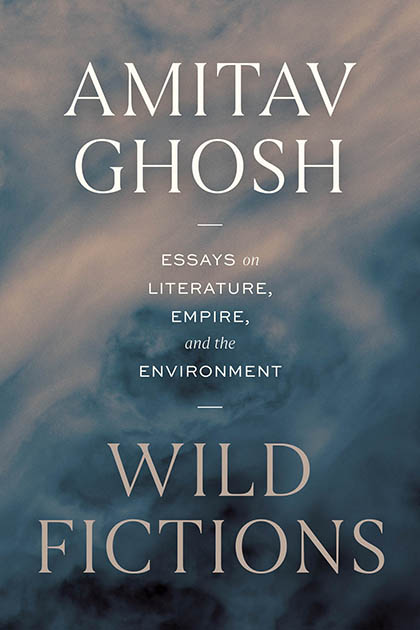
Amitav Ghosh. Wild Fictions: Essays on Literature, Empire, and the Environment. Chicago: University of Chicago Press, 2025. 478 pp.
Review by Lawrence Buell
23 December 2025
Wild Fictions collects twenty-six pieces, short and long, that span the arc of Amitav Ghosh’s distinguished career as novelist, ethnographer, environmental humanist, literary critic, journalist, and cultural historian. Loosely ordered under six rubrics—climate change and environment, witnesses, travel and discovery, narratives. conversations, presentations—Wild Fictions can instructively be read in several overlapping ways.
First, the book offers a unique window onto the development of the author’s core interests during the past forty years, in particular his increasingly wide-angled and trenchant critique of British and other Western imperialisms, of the intertwinement of Enlightenment and Empire more generally, and of the intertwinement of these with the challenges of environmental imagination in the Anthropocene Age.
Second and relatedly, Wild Fictions provides a series of revealing glimpses of the experiences that motivated some of the major turning points in the author’s intellectual odyssey and the shape of the works for which he is most famous, such as In an Antique Land, the Ibis trilogy, and The Great Derangement. Two especially eye-opening examples, both previously unpublished, are Ghosh’s correspondence with Dipesh Chakrabarty over the latter’s Provincializing Europe (chapter 19), and his 2008 lecture on “The Making of In an Antique Land” (chapter 23). The first showcases Ghosh’s commitment to getting history right in both fact and theory and augurs the turn in his later work to more concentrated and polemic engagement with the baleful legacies of empire, especially in south and east Asia. The second offers a more intimate but no less astute and penetrating account of the emergence of Ghosh’s masterful sense of the interweave between history, narrative, ethnography, cultural migration, and zest for travel that are central not only to that one seminal book but to much of his major work since.
Third, the collection can be selectively read for its handful of most searching and powerful essays, my own favorites being the opening chapter, “The Great Uprooting: Migration and Displacement in an Age of Planetary Crisis”; the title chapter, “Wild Fictions” (chapter 10); and “Storytelling and the Spectrum of the Past” (chapter 22). The first unpacks the relation between climate and migration with special emphasis on the surprising technological savvy, for better or worse, of today’s migrants from developing world to Euro-world. The second appraises the workings of contested environmental imaginations, official versus vernacular, especially in modern India, as the latter have struggled against the ethnic cleansing effect of top-down protectionist designs. The third reflects on the relation between the historian’s craft and the art of historical fiction with special reference to the Ibis trilogy of novels about the British-Sino-Indian opium trade in the early nineteenth century. The last of these essays was published in a major scholarly journal. All three could easily have been had the author so wished.
All three, happily, are also eminently readable by nonspecialists, as is all of Ghosh’s work however erudite. He has never been comfortable for long operating within standard cloistral venues or protocols, and this collection testifies to that as well, as in “Confessions of a Xenophile” (chapter 13), a delightful familiar essay where the author as inveterate traveler is in the ascendant; and a dozen of more pieces short and long that demonstrate the investigative passion for unearthing oral or documentary testimony by obscure or forgotten witnesses that movingly refute official accounts or wars and other crises, like four chapters that feature overlooked testimony by Indian enlistees in World War I swept up in Britain’s most disastrous Middle Eastern campaigns.
Now at the summit of his career, Ghosh is widely, and understandably, reckoned a strong contender for Nobel literature honors. Should that final assize come to pass, this miscellany will not weigh so heavily as such sustained achievements as In an Antique Land, The Glass Palace, The Hungry Tide, the Ibis trilogy, The Great Derangement, and The Nutmeg’s Curse. But many of the essays in Wild Fictions are indispensably revealing pendants to those major works; and the best of them no inquiring reader with even a passing interest in the issues in question will want to miss.