Critical Inquiry Critical Inquiry

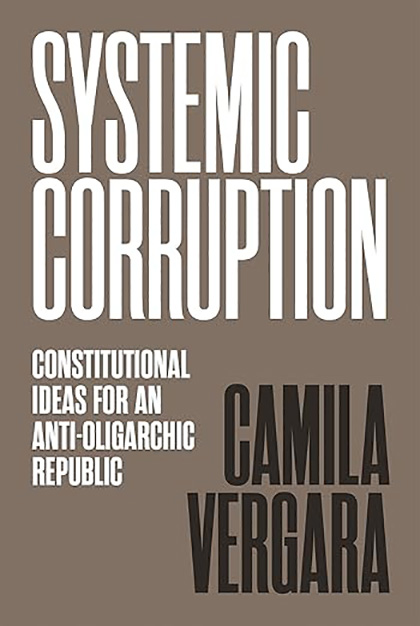
Camila Vergara. Systemic Corruption: Constitutional Ideas for an Anti-Oligarchic Republic. Princeton, N.J.: Princeton University Press, 2020. 312 pp.
Review by Mikkel Flohr
11 December 2025
Camila Vergara’s Systemic Corruption: Constitutional Ideas for an Anti-Oligarchic Republic is a bold and imaginative work of republican political theory that combines original reinterpretations of the history of political thought with elaborate institutional proposals for reforming liberal democracy today in order to counter its oligarchic tendencies and decay. The book is divided into three parts. The first part starts from the problematic of systemic corruption, which Vergara identifies with the continuous and systematic (fully legal and institutionalized) accumulation of wealth and power amongst elites. Liberal democracies remain unable to address this oligarchization because they conceive their constituency as an undifferentiated people and cannot grasp or address its internal divisions.
Vergara therefore turns towards republicanism, which has historically focused on the division and conflict between the few and the many and proposed a so-called mixed constitution as a means of dividing power between them and counteracting tendencies towards oligarchic domination and destabilization. Vergara identifies two strands of republican thinking about the mixed constitution, distinguishable by their attribution of final decision-making power to either the few or the many. While the former elitist-proceduralist strand has historically been dominant and remains so to this day, Vergara wants to recover and develop the latter plebeian-materialist strand.
The second part of the book recovers central parts of this lost plebeian-materialist republican tradition of constitutional thought as a means of generating novel institutional solutions to the systemic corruption of contemporary liberal democracy in the third part of the book. Vergara starts from Niccolò Machiavelli’s understanding of society as divided into a powerful elite and a common people whose power must be institutionalized to create a free and stable society. There can be no illusion of equality before the law or of class-neutral institutions—both central features of contemporary liberal democracy or, seemingly, even a horizon of a classless society. There will always be a division between the elites who rule and the common people who are ruled. It is therefore necessary to develop institutions that will delimit the authority of the elites and allow the common people to check and resist their power. Vergara looks to Nicolas de Condorcet’s designs for a representative assembly accountable to a network of local primary assemblies, Rosa Luxemburg’s and Hannah Arendt’s engagement with council democracy, and John McCormick's and Lawrence Hamilton’s proposals for reviving the plebeian tribunate.
The third and final part of the book engages with contemporary republican thought and develops detailed institutional plans for a fourth plebeian branch of government that can be integrated in contemporary liberal democracies (in an epilogue aptly titled “What is to be done?” she also proceeds to address how this might be attained). This fourth branch would consist of an expansive network of popular local assemblies with the power to both initiate and block legislation, policies, appointments, and more, and a plebeian tribunate with the power to enforce the former’s decisions and prosecute officials. The aim is not to realize popular power as such, but to create popular, anti-oligarchic institutions that can check the power of elites and counteract liberal democracy’s tendency towards systemic corruption and the resulting decline and decay. In this regard, Vergara’s work is a bold and provocative proposal for how to reform, rather than replace, liberal democracy. The imaginative use of the history of political thought to develop concrete institutional proposals that address the contemporary crisis of liberal democracy is inspiring, even if such concrete institutional proposals are always easy to fault or disagree with, but that would be to miss the point. The point of this book, the way that I read it, is to get us started thinking about how we might (re-)organize our collective lives so as to overcome rampant systemic corruption.
Despite these virtues, the commitment to the model of the mixed constitution remains underdeveloped. It is never sufficiently elucidated why the plebeian-materialist strand of republicanism must necessarily accept and accommodate a ruling elite in its (mixed) constitutional design. In this regard, Vergara’s plebeian republican constitutionalism appears more concerned with counteracting the destabilizing effects of systemic corruption on liberal democracy through a mixed constitution than with overcoming oligarchic rule and establishing democracy. While it seems plausible that we may never be able to fully eliminate the possibility of elites emerging and consolidating power—and should therefore continue to maintain measures to counteract and contain oligarchization—it does not necessarily follow that we should stop trying to overcome the split between rulers and ruled and simply accommodate the rule of elites as a necessary evil.