Critical Inquiry Critical Inquiry

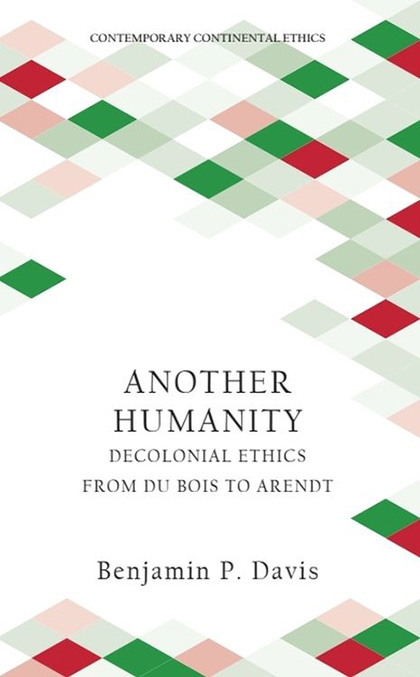
Benjamin P. Davis. Another Humanity: Decolonial Ethics from Du Bois to Arendt. Edinburgh, Edinburgh University Press, 2025. 288 pp.
Review by Santasil Mallik
21 May 2026
Of the many critiques of humanism that produced a litany of other -isms in the postwar decades, those from the site of anti-racial and anti-colonial politics have established a veritable critical lineage to address the enduringly difficult question of humanitarian rights. In Another Humanity, Benjamin P. Davis reexamines the concepts of the human and humanity from within this tradition while resisting the contemporary trend of entirely jettisoning them à la Achille Mbembe, Walter Mignolo, and Alberto Moreira, to name a few theorists. Imagining alternative social realities, Davis argues, does not necessitate transcending existing conceptual frameworks as much as it asks us to “truly live out” their potentialities in order to “build new coalitions, collectives and communities” (pp. 21, 29). Therefore, he attempts to articulate humanism against the attendant epistemological certainties grounded in Western social science, and his methodological premise partakes in what Gayatri Chakravorty Spivak calls “affirmative sabotage.”[1]
W. E. B. Du Bois’s criticism of the 1944 Dumbarton Oaks proposals—the blueprint for the United Nations (UN)—for disregarding the self-determination of European colonies, followed by his shaping of the 1947 NAACP petition to the UN to expose racial discrimination in the United States, informs the historical background of the book’s opening chapter. Davis reads these sources to underscore how Du Bois approached the human as a “universalising practice” in racialized modernity, not as a universal concept (p. 75). This mutation of the term from noun to verb is what Davis further traces in the work of Édouard Glissant throughout the second chapter, as the Martiniquan kin of Frantz Fanon and Aimé Césaire emphasized “a poetics” of minor, relational humanism over hermetic systems (p. 112). The opening chapters set the theoretical scope of the book, whereas the remaining three reflect on its lived, practical dimensions in today’s geopolitical reality by turning to Sylvia Wynter (“Ceremonial Humanism”), Edward Said (“Postcolonial Humanism”), and Hannah Arendt (“Ordinary Humanism”).
Another Humanity is remarkable for its sustained passages of close reading, where Davis thinks with and against the critical theorists to envision decolonial approaches to humanism. His personal encounters with certain politico-ethical circumstances, be it attending a small ceremonial gathering with Anishinaabe men in rural Minnesota or receiving a gift from a stranger in Nablus, productively frame the questions through which he engages with Wynter, Said, and Arendt. Particularly rewarding are his textual sources, ranging from Said’s personal journals to Arendt’s correspondence with her teacher Karl Jaspers. However, when Davis refers to the contradictions in the thought of his interlocutors, such as Du Bois’s view of Palestinian Arabs as fanatic Islamists in 1948 or Arendt’s reservations against racial integration in schools, they are mostly anecdotal. He does not develop them fully in their aporetic complexities, even though his refutation of “an ethics of purity” remains credible (p. 94). It is because Davis primarily follows a citational trail to underscore how theories of humanism “travel,” to use Said’s term, from one thinker’s oeuvre to another’s, rather than also accounting for the distinct yet overlapping historical conditions of their emergence (p. 38).
This nonetheless does not eclipse the book’s virtuosic readings and consistent argument for a strategic détournement of humanism. In solidarity with the experiences of the dispossessed, Davis joins a tradition of decolonial theorists to reclaim the terrains of humanist thought against its insidious legacies. The implications of returning to questions of the human and humanity are ever more urgent today, when humanitarian catastrophes are becoming the norm underpinning the present world order. Antonio Gramsci asked: “But is ‘humanity,’ as a reality and as an idea, a point of departure – or a point of arrival?”[2] Davis seems to suggest that it is both at once and more. It is a horizon of perpetual praxis with recurring returns.
[1] Gayatri Chakravorty Spivak, An Aesthetic Education in the Era of Globalization (Cambridge, Mass., 2012), p. 510.
[2] Antonio Gramsci, “What is Man?” in The Modern Prince and Other Writings (New York, 1968), p. 79.