Critical Inquiry Critical Inquiry

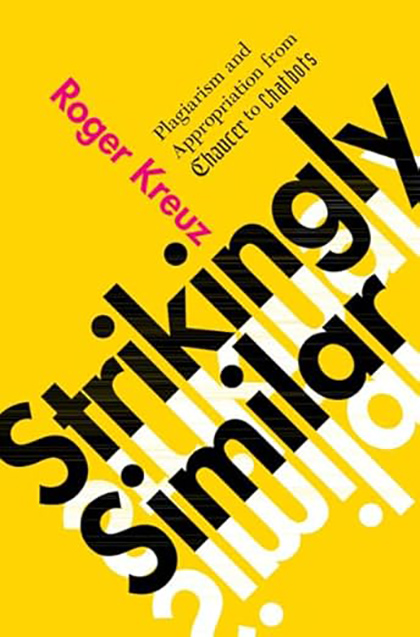
Roger Kreuz. Strikingly Similar: Plagiarism and Appropriation from Chaucer to Chatbots. New York: Cambridge University Press, 2026. 240 pp.
Review by Zheng Wang
27 March 2026
Plagiarism has always been a moral drama, but it is now also an infrastructural condition. In a culture that detects similarity as routinely as it produces it—through search engines, plagiarism software, rights-management systems, and, increasingly, generative AI models—the charge of plagiarism functions less like the discovery of an intrinsic transgression than like a way of governing textual circulation and redistributing credibility. Roger Kreuz’s Strikingly Similar is valuable precisely because it refuses to treat plagiarism as a self-evident sin. Instead, it tracks how similarity becomes actionable: what counts as copying, who is authorized to name it, and what institutional work the accusation performs.
Kreuz built his archive of cases “as someone might do if they were collecting butterflies or old coins” (p. x). The book’s wry epigraphic line, “Plagiarism: it’s not just for mediocrities anymore,” announces its argument about scope: politicians, bestselling authors, prizewinners, and elite academics populate Kreuz’s case history, which is why the book succeeds as an anatomy of modern authorship under pressure (p. xi).
A signature strength of the book is its procedural intelligence. “Plagiarism hunters,” editors, administrators, and litigants turn resemblance into evidence through thresholds and tools (pp. 29–59). What looks like objective detection is always embedded in institutional incentives—who benefits from exposure, who risks reputational ruin, and who gets to frame a narrative of deception. Kreuz’s discussion of “unconscious plagiarism” and creative memory is most persuasive not because it definitively settles intent but because it shows why intent becomes a proxy battle over authority, sympathy, and punishment (pp. 60–88).
“One way to define plagiarism,” he writes, “would be to describe it as the opposite of originality” (p. 4). The sharper question is how originality became the cultural gold standard—an ideology of authorship that converts certain borrowings into legitimate influence while criminalizing others as theft.[1]
On generative AI, Kreuz names the public threshold: ChatGPT 3.5 marks “a historic moment” (p. 188). If students submit chatbot output, is that plagiarism? He argues it has “more in common with ghostwriting” because “there is no ‘original’ that is being copied” (p. 191). The distinction shifts the debate from resemblance to delegated agency—who speaks, who is credited, and what authorship now includes.
Yet the AI material also exposes a limit of the book’s case-based method. If the scandal is no longer simply copying but infrastructural authorship—models trained on vast textual ecologies and institutions scrambling to police credit—then plagiarism can become an inherited moral vocabulary for a new political economy. The pressing question becomes less “Who copied?” than “Who benefits from similarity, and who bears the risk when similarity is discovered?” Even so, Strikingly Similar offers an indispensable archive and a lucid set of mechanisms for thinking about similarity across time.
[1] See Michel Foucault, “What Is an Author?” in Language, Counter-Memory, Practice: Selected Essays and Interviews, trans. Donald F. Bouchard and Sherry Simon, ed. Bouchard (Ithaca, N.Y., 1977), pp. 113–38.