Critical Inquiry Critical Inquiry

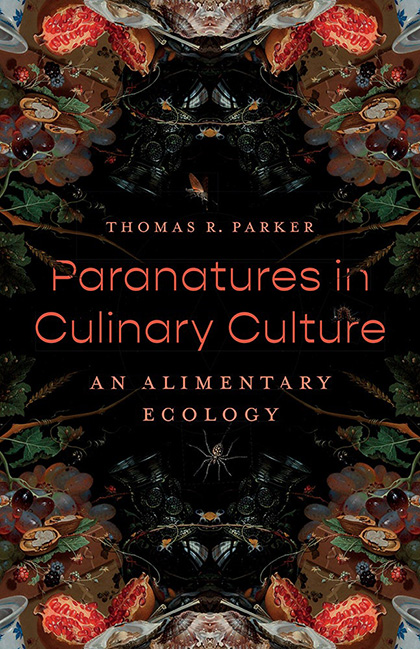
Thomas R. Parker. Paranatures in Culinary Culture: An Alimentary Ecology. Minneapolis: University of Minnesota Press, 2025. 296 pp.
Review by Lida Zeitlin-Wu
9 April 2026
At a seafood shack on North Carolina’s Outer Banks in October 2025, I had an unsettling experience. An unidentified but evidently alert creature, nearly translucent, was nestled against my oyster in its shell—and it had legs. “Oh, that’s a pea crab,” the server explained cheerfully. “They’re a sign that the water’s clean. Some people say they bring good luck.” As it turns out, the pea crab (Pinnotheres ostreum) has a parasitic relationship with its bivalve host, using it for both shelter and nutrition. Ultimately, I was too squeamish to eat the pea crab, this pale alien thing forcing me to confront my own hypocrisy: that the oyster I was about to consume was, too, alive.
Thomas R. Parker describes a similarly squeamish encounter with his first pea crab in the playful and idiosyncratic Paranatures in Culinary Culture: An Alimentary Ecology. While he would have preferred to release both crab and oyster into the wild, he decides, “according to some twisted rationale,” that the only solution is to eat both: “I had already irretrievably broken their home, and the crab had reified the pair’s living presence, making me realize the finality of what I had done” (p. 111). Oysters (and shellfish more generally), alongside bread, wine, pigs, and cheese, possess what Parker dubs a uniquely paranatural ontology: they live a “double life,” existing as both discrete objects as well as agents of transformation (p. 12). In brief, “paranature” combines architectural critic David Gissen’s concept of subnature with philosopher Michel Serres’s work on the parasite. The former refers to unruly and marginalized aspects of the built environment (such as smoke, debris, vermin, and weeds), while the latter theorizes the parasite as a catalyst for disruption across biological, social, and informational systems.[1] Parker argues that paranature has the capacity to subvert an anthropocentric and often Western-focused worldview because it “is to nature exactly what noise is to music: an interrupter” (p. 7). The book therefore reflects a growing shift within critical food studies away from discrete commodities to the relational act of eating—often by focusing on textures and flavors that blur the boundaries between animacy and inanimateness, order and disorder, desire and disgust.[2]
Paranatures, which spans nearly every continent and covers antiquity to the present, is a departure from the author’s previous two books, which focused firmly on early modern France.[3] Indeed, its stated goal is to offer “nothing less than a destabilization of the Western idea of nature through a survey of recalcitrant foods; and showing how their noise is amplified in a significant way when traditions and cuisines that were taken to be Western turn up in non-Western traditions and culinary practices” (p. 8). Tracing a transhistorical odyssey, let alone a global one, is a tall order, and the book’s disciplinary investments are equally ambitious. Originating from a collaborative Humanities Writ Large grant at Duke, the project experiments with both method and style, mixing auto-ethnography with new materialist aesthetics, object-oriented ontology (OOO), semiotics, and ecological and decolonial critique. Paranatures offers up a fascinating archive of painting, literature, folktales, philosophical treatises, and tasting rubrics, among other materials.
That said, the book’s eclectic sprawl may not be for everyone, and sections like “How Cheeses Think” or claims that “one can feel the oyster actively resisting the simplification that occurs” in a sixteenth-century Dutch still life will likely frustrate readers who are less enamored with OOO (p. 99). At times, the book also inadvertently buttresses the very notions of nature and culture it seeks to deconstruct. This is especially true in the wine chapter, which waxes poetic about the natural wine movement’s redefinition of terroir (on cult Etna winemaker Frank Cornelissen, Parker writes: “To drink Cornelissen wines is to live a story in connection with the earth the wine comes from: it is to embrace the aesthetic of precarity, fragility, and changeability” [p. 226]). Additionally, the chapter’s assertion that natural winemakers in Europe draw on a uniquely “Japanese notion of nature” that likewise explains the “Japanese proclivity for natural wine” ultimately reinscribes the binary between Western and non-Western more than it transcends it (pp. 229, 234). Nevertheless, Paranatures offers a compelling and portable framework that urges scholars to take food and drink seriously as objects of posthumanist thought.
[1] See David Gissen, Subnature: Architecture’s Other Environments (New York, 2009); see also Michel Serres, The Parasite, trans. Lawrence R. Schehr (Minneapolis, 2007). For a very different application of Serres, see Anna Watkins Fisher, The Play in the System: The Art of Parasitical Resistance (Durham, N.C., 2020).
[2] See Kyla Wazana Tompkins, Deviant Matter: Ferment, Intoxicants, Jelly, Rot (New York, 2024).
[3] See Thomas R. Parker, Volition, Emotion, and Rhetoric in the Work of Pascal (New York, 2008) and Tasting French Terroir: The History of an Idea (Oakland, Calif., 2015).