Critical Inquiry Critical Inquiry

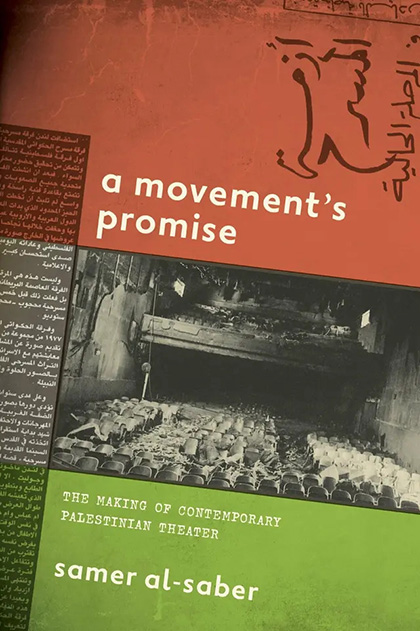
Samer Al-Saber. A Movement’s Promise: The Making of Contemporary Palestinian Theater. Stanford, Calif.: Stanford University Press, 2025. 328 pp.
Review by Marissa Fenley
1 May 2026
“Should the theater movement focus on nationally urgent content or the aesthetic development of theater practice?” (p. 211) This unresolved question galvanizes both Samer Al-Saber’s book, A Movement’s Promise: The Making of Contemporary Palestinian Theater and the Palestinian theater movement which is its subject. In asking this question, Al-Saber situates the center of Palestinian theater in Palestine—and even more specifically, in Ramallah and East Jerusalem during the 1970s and 1980s —rather than juxtaposing the Palestinian theater with Israeli and Zionist cultural production and thus displacing Palestinian theater to an ever shifting, contested periphery.
In his commitment to both centering and centralizing the Palestinian theater movement, Al-Saber tells a story with two central protagonists. The first is the pragmatic and traditional George Ibrahim, whose willingness to cooperate with and work within Israeli cultural institutions cost him a great deal of popularity but allowed him to pioneer a successful production model for the Palestinian theater. The second is the iconoclastic and polarizing François Abu Salem, whose artistic ambition and political radicalism forged a distinct aesthetic style for the Palestinian theater even as he often alienated his many collaborators and destabilized the very ensembles he was famous for convening. And yet Al-Saber does not position his book as a biography of these two men; rather, he tracks the movement that assembled and fractured and reassembled around them in order to capture the “dynamic and pluralistic collective spirit of the theater movement in the 1970s” (p. 252).
A Movement’s Promise is thus both an institutional history of a theater movement under occupation and a reconstruction of its style, methods, aesthetics, and innovations. The Palestinian theater, as Al-Saber presents it, is marked by its distinct method of participatory aesthetics, the juxtaposition of explicit debate and abstract stylization, and a wide, sometimes untraversable gap between a legible story and its theatricalization onstage. The demand for ambivalence in both form and content was at once aesthetic and institutional: it allowed for the expression of a political community marked by factionalism to convene in “a site for free thought and a battleground that did not require forbidden arms” while evading censors by putting up stories that, to a Jewish-Israeli sensibility, appeared so tedious and boring they would prove a "'punishment'" to their audiences (pp. 35, 223). Al-Saber thus demonstrates that the character of the Palestinian theater movement was shaped by both a set of political ideals and its material conditions.
Against this backdrop, however, the style of Palestinian theater takes on its own distinct character that cannot be reduced to its political context. Marked by sumud or steadfastness, the Palestinian theater movement demanded both its audiences and performers “choos[e] to stay present and living” (p. 32) The unique theatricality of this movement is what most forcefully shines through in A Movement’s Promise, which delivers stunning moments of theatrical clarity, enviable to both theater scholars and practitioners alike (Al-Saber is, quite notably, both). Balalin’s (The Balloons) 1972 performance Al-‘atma (The Darkness) engaged an ingenious meta-theatrical conceit where the company discovered at the start of the show that the lighting board didn’t work, and the ensuing production entailed the cast and the audience joining forces to try and fix the lights together. In Bila Lin’s Musara’a Hurra (Free Wrestling), audiences had to make decisions about where to sit in the theater based on their class position, which would determine which wrestler they rooted for, in a satire of the 1973 Geneva Conference. In Sundouq Al-‘ajab’s production Lamma Injanina (When We Went Crazy!), characters literally ate newspapers, representing the twin evils of poverty and news obsession.
At its height, the Palestinian theater movement was marked by this combination of extreme physicality, participatory form, and meta-theatricality, which culminated in a forceful critique of occupation. However, by the 1980s, once this movement consolidated largely under the umbrella of El-Hakawati, Abu-Salem’s longest running theatrical ensemble, and George Ibrahim’s Al-Kasaba Theatre, both the politics and aesthetics of the movement became either increasingly opaque (in order to avoid direct confrontation with Israeli officials) or diluted (in order to receive foreign funding, projects needed to emphasize Arab-Jewish coexistence). The nationalization of Palestinian theater that took place after Arafat’s 1988 announcement of an independent Palestinian state brought in more money for cultural institutions, but this money came with strings. Leaders in the theater were forced to speak "the language of community service, capacity building, intercultural dialogue, and self-critique” and those who “rejected or were ill-equipped to play the new compulsory performance of reform” disappeared (p. 256). And as companies like El-Hakawati toured the West and Al-Kasaba made production with hybrid Palestinian and Israeli casts, they were often met with Orientalizing sympathy or blatant discrimination (may the Public Theater in New York be forever haunted by their cowardice in canceling El-Hakawati’s Story of Kufur Shamma in 1989 and the Freedom Theatre’s The Siege in 2017).
Yet, reading A Movement’s Promise, the words of one Israeli military governor ring in our ears: "'We prefer bombs to your intellectual theater-making because we know how to deal with bombs'" (p. 164).