Critical Inquiry Critical Inquiry

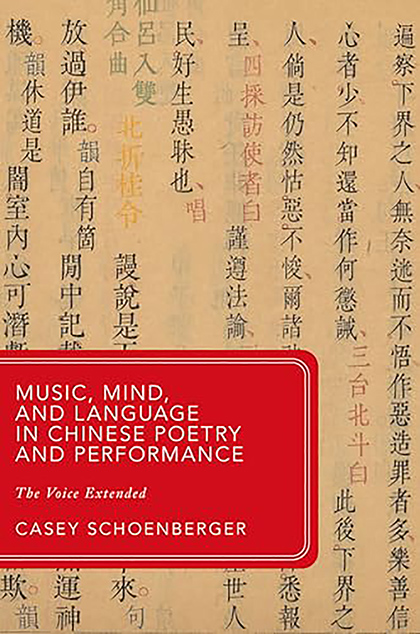
Casey Schoenberger. Music, Mind, and Language in Chinese Poetry and Performance: The Voice Extended. New York: Oxford University Press, 2024. 303 pp.
Review by Susanna Sun
2 April 2026
Casey Schoenberger innovatively reframes Chinese poetic and operatic traditions as systems in which language, melody, and practice are co-constitutive cognitive ecologies. Drawing upon the “Extended Mind Thesis” (EMT), which holds that cognition is not trapped within the individual’s brain but is distributed across the body, tools, environment, and social practices, Schoenberger repositions technical elements or conventions of Chinese poetic and musical traditions as modes of thinking that are distributed, externalized, and historically cumulative. Schoenberger rejects strict divisions between the communicative and aesthetic functions of language and proposes song and speech as a continuum, a spectrum between “songful” and “speechlike” qualities (p. 79). Meaning and aesthetics emerge through repetition, constraint, expectation, and material conditions.
The book itself subtly advances through a progressive widening of scale that reflects a pattern of “‘spiraling’”: he begins with micro-level changes in rhythmic embodiment (Chapter 1, “The Death of Rhythm”), moves to the emergence of melodic structuring that reshapes sound-meaning relations (Chapter 2, “The Birth of Melody”), then shifts to macro-level social circulation of language and form beyond individual speakers (Chapter 3, “Languages without Native Speakers”), and finally theorizes collective pattern systems that generate music without singular authorship (Chapter 4, “Music without Composers”) (p. 242). In the Coda, “Lively Rhythms of Equal Lines, Ever-Present Past,” Schoenberger circles back to his definition of spiraling—the powerful process where changes in the material and social world are “progressively enfolded within the artistic and literary vocabularies of artists and audiences, becoming seeds of future manipulation and creativity” (p. 242). This is one of the book’s most original conceptual contributions.
The concept of spiraling correlates with a reconceptualization of historicity and the formation of culture. For Schoenberger, history functions as a cumulative but nonlinear cognitive-material ecology that produces patterned regularities—such as “chunking,” schemata, and grammars—through recursive interaction among minds, media, and social coordination (p. 20). This fresh view of history clarifies how traditions can sustain cultural legibility across centuries despite radical transformations, thus challenging prevalent periodization models that isolate premodern, traditional, and modern as discrete cultural regimes. Schoenberger suggests that cultural forms can be reimagined as palimpsests, each composed of elements with different temporal depths. Thus, a single performance can simultaneously contain Zhou Dynasty rhyming structure, Tang Dynasty tonal practice, late-Ming formulaic convention, and twentieth-century ideological inflections. Inherited forms survive by being continually reactivated, recalibrated, and redistributed across bodies, media, and social conventions—the “ever-present past” (p. 235).
By treating melodic and prosodic forms as historically embedded cognitive systems rather than stable cultural essences, Schoenberger repositions cultural authenticity as historical functionality: how particular configurations of sound and language remain intelligible, transmissible, and effective within certain performance ecologies. Such a transcultural approach destabilizes what are considered to be distinctive features of Chinese poetry and music. For instance, in Chapter 4, Schoenberger suggests that the “Open-Receive-Turn-Close” pattern, a poetic-musical structure long regarded as a paradigmatically unique feature of Chinese poetry, is in fact a form of expectation management on a cognitive level: a circular dynamic of “expectation creation-denial-fulfillment” that other cultures realize as well, as in the Western sonata form of “exposition, development, recapitulation” (pp. 187, 190, 226). Through such layering, Schoenberger puts existing assumptions of creativity and authorship in flux, noting that the genius of a Chinese librettist-composer lies in their ability to allude to and deploy existing patterns innovatively.
Since we have no recordings from most of the history of these art forms, how can we trace their performance histories, and what do we make of the written traces of performed lyrics that once moved listeners? For Schoenberger, performance is neither irrecoverable ephemerality nor romantic fantasy. We can and should “situate poetry and music’s formal aspects and the minds that created, read, voiced, and listened to them within a broader matrix of social minds and material innovation” (p. 235). That broader matrix reinscribes texts and objects within reproducible architectures organizing perception, attention, and affect.
Such an approach is better at explaining the consistency and continuity of cultural transmission than its fragility, contingency, and unevenness. It risks smoothing over the moments where performance strains against its own systems: where voice falters, timing breaks, affect exceeds form, or gendered bodies bear uneven cognitive and physical demands. It also elides presence, which, beyond the “ever-present past” mentioned in the book, is the immediate, atmospheric, and possibly precarious condition through which performance becomes perceptible at all. More importantly, because EMT, at its core, extends the individual mind and consciousness into a collective, it can lead to the flattening and homogenization of performers’ bodies into passive vehicles for transmitting cognitive patterns. It cannot fully take into account the performer’s personal agency, including the uniqueness of their voice and body, their aesthetic judgment, and spontaneous improvisation, which can revolutionize the patterns and textures of music tunes. As a performer-scholar of Chinese opera, I also see how such an approach could risk indifference to the actor’s experience of their body, which is painfully disciplined and cultivated. Moreover, solely focusing on the cognitive approach as the explanatory mechanism risks over-attributing causality to symbols, patterns, and systems. Kun Opera’s “melismatic” tunes likely owe more to the expressivity of emotional complexity or the materiality and musicality of the accompanied bamboo flute than the visual resemblance to the twisting shapes of the “neume ligatures” in Daoist music notation symbols (pp. 3, 95).
Music, Mind, and Language in Chinese Poetry and Performance introduces a methodological and epistemic reorientation that breaks with philological dominance and genre-bound historiography, powerfully connecting all-too-often separated spheres of Chinese literary, cultural, and performance studies. By relocating the work of cognition from texts and individuals to historically durable systems of practice, this book compels us to ponder fundamental questions about culture—where tradition resides, how creativity operates, and what counts as knowledge.