Critical Inquiry Critical Inquiry

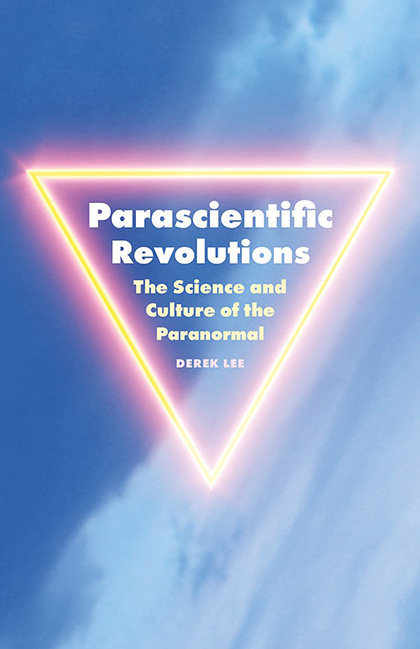
Derek Lee. Parascientific Revolutions: The Science and Culture of the Paranormal. Minneapolis: University of Minnesota Press, 2025. 304 pp.
Review by Wolfgang Boehm
7 May 2026
In Parascientific Revolutions: The Science and Culture of the Paranormal, Derek Lee offers parascience as a theoretical term to describe “the site for the production and circulation of pseudoscientific ideas” (p. 19). Parascience is a nonjudgmental conceptualization of the porous and blurry boundaries between science and culture that contribute to the formation of pseudoscience. It signifies a space where folk belief, discredited scientific ideas, art, literature, non-Western and Western science, and metaphysics interweave. For Lee, parascience is not just a cultural curiosity but a Foucauldian counter-discourse that “produces new types of knowledge” (p. 20). In this counter-discourse, discredited hypotheses of Western science are picked up by science fiction, which Lee argues serves as a primary parascientific laboratory. Another key laboratory is ethnic fiction, where ideas originating from non-Western and indigenous science not accepted by hegemonic discourse bring non-European cosmologies into dialogue with the cliché of secular modernity.
Each chapter explores paranormal attributes of the mind, like precognition of the future, telekinesis, remote viewing, communication with the dead, and telepathy. Their structures are similar, each following the journey of a particular claim from Western or indigenous science to pseudoscientific publications, science fiction, and ethnic fiction. The first chapter involves the idea of precognition in early modern psychology and its second life in literature, using Alan Moore’s The Watchmen (1987) and Philip K. Dick’s novel VALIS (1981) as case studies. The second follows New Age philosophers inspired by the Gaia hypothesis, using Greg Bear’s two novels about microbial mind control, Darwin’s Radio (1999) and Vitals (2002), as theoretical expansions of the biological-paranormal mind. The third retells the history of the United States government’s Cold War investment in remote viewing, or the ability for someone to detach their mind from their body and spy on events occurring anywhere in the world, which Lee argues treats the paranormal mind as a technology. The fourth and fifth chapter take works of ethnic fiction as instances of indigenous and non-Western science. Lee argues that Korean shamanism in Nora Okja Keller’s Comfort Woman (1997) and the Chinese idea of qi in Amy Tan’s The Hundred Secret Senses (1995) provide alternative approaches to paranormality that depart from the hegemony of Western science, particularly regarding the perceived ability of the mind to act as a medium with the dead. Meanwhile, Ruth Ozeki’s A Tale for the Time Being (2013) and Sesshu Foster’s Atomik Aztex (2005) offer a similar approach to telepathy. In his concluding chapter, Lee reminds readers that the paranormal mind still grips us in both the West and non-West alike.
One question that I repeatedly returned to involves parascience’s conceptual elasticity. On the one hand, Lee is less concerned with “the science and culture of the paranormal” but specifically with what he calls the paranormal mind. Readers expecting UFOs, demonic possession, poltergeists, or the Loch Ness Monster will be disappointed (while he discusses ghosts, they are understood in relation to a mind that communes with the dead). On the other hand, parascience is at times presented as involving all non-hegemonic science. This issue of scope leads to several interrelated questions. What is special about parapsychology? Can all pseudoscience be understood as participating in the counter-discourse of parascience? Where do the anti-evolution theories of Christian evangelicalism fit, or the decades of junk science produced by the fossil-fuel industry? Acknowledging this point, Lee writes that we must understand “oddball science” in all its forms while insisting that the paranormal mind is of a different category than, for example, anti-vaxxers (p. 214). In other words, not all oddball sciences are the same. And yet, part of the theoretical power of parascience is its ability to describe a shared arena and process of circulation by which non-accepted scientific ideas contribute to a form of knowledge. How then can we avoid placing, for example, Korean shamanism within a Foucauldian counter-discourse that includes in its borders the myth of clean coal?
Nonetheless, Parascientific Revolutions offers significant theorization of the relationship between science, pseudoscience, and literature. Lee excels at weaving together disparate histories and masterfully tracks the circulation of ideas between science and literature. To those tired of hackneyed responses to post-truth handwringing, Lee’s theory of “parascience” provides a refreshing way to think generatively about a world many are quick to dismiss and condemn. Neither judgmental nor effusive, pseudoscience is not treated as mere social pathology but as a phenomenon that needs to be understood, which he sets out to do.